Targu Lapus is a serene town nestled in the heart of Maramures, northern
Transylvania, Romania.
Surrounded by rolling hills, forests, and rivers, it offers a tranquil
landscape shaped by centuries of rural life and spiritual tradition. The town
administers thirteen villages and serves as a cultural and historical center
for the region. Its charm lies in its blend of traditional wooden
architecture, artisanal crafts, and warm hospitality. Visitors encounter a
living rhythm of festivals, local cuisine, and sacred sites, including the
Church of the Holy Archangels, which anchors the town’s spiritual presence.
The nearby Blue Lake and natural reserves add layers of ecological wonder to
its cultural depth.
Lapusului Country, named after the Lapus River, is a region of deep historical
and spiritual resonance. Documented as early as 1070, it stretches across
gorges, cliffs, waterfalls, and caves, forming a protected natural reserve
rich in wild flora and fauna. The Lapus Gorges, with their canyon-like
formations and sacred rock faces, evoke a primordial landscape where nature
and myth converge. This region is also home to the Poiana Soarelui Sculpture
Park, a monumental open-air museum that blends contemporary art with ancestral
terrain. Lapusului Country preserves a distinct identity within Maramures,
marked by its animist echoes, folk wisdom, and enduring connection to the
land.
Nearby, the wooden churches of Maramures stand as spiritual sentinels of
Romanian heritage. Built without nails, using ancient carpentry techniques,
these churches embody a sacred geometry and humility that reflect the soul of
the region. Surdesti, Budesti, and Poienile Izei are among the most revered,
each with tall spires, painted interiors, and a quiet dignity that invites
contemplation. Their spirituality is not only Christian but deeply
folkloric—woven with ancestral memory, seasonal rites, and the whisper of
forest spirits. These churches are living altars of transmission, where
prayer, silence, and craft converge into a ritual of presence.
|
Holy Trinity Church
The Holy Trinity Church in Breb, part of
the Ocna Sugatag commune in Maramures, Romania, stands as a modern
spiritual landmark within a landscape steeped in ancestral tradition.
-
Built in 1981 from brick and concrete, it rises prominently above the
village, its tower visible from afar as one approaches Breb. Located
within the cemetery, the church marks a threshold between the living
and the dead, offering a place of prayer, remembrance, and continuity.
Though newer than the famed wooden churches of the region, its
presence is no less significant—it reflects the evolving architectural
language of faith in Maramures, blending modern materials with
enduring devotion.
-
Inside, the Holy Trinity Church serves as a gathering place for
Orthodox liturgy, seasonal rites, and village ceremonies. Its
construction echoes the communal effort and spiritual resilience of
the people of Breb, who maintain both this newer sanctuary and the
older wooden church nearby. The contrast between the two
structures—one built of concrete, the other of carved timber—embodies
the dialogue between past and present, permanence and impermanence.
The church’s dedication to the Holy Trinity invokes themes of unity,
protection, and divine order, anchoring the village’s spiritual life
in a triadic rhythm that resonates with both Christian theology and
the symbolic cycles of the land.
|
|
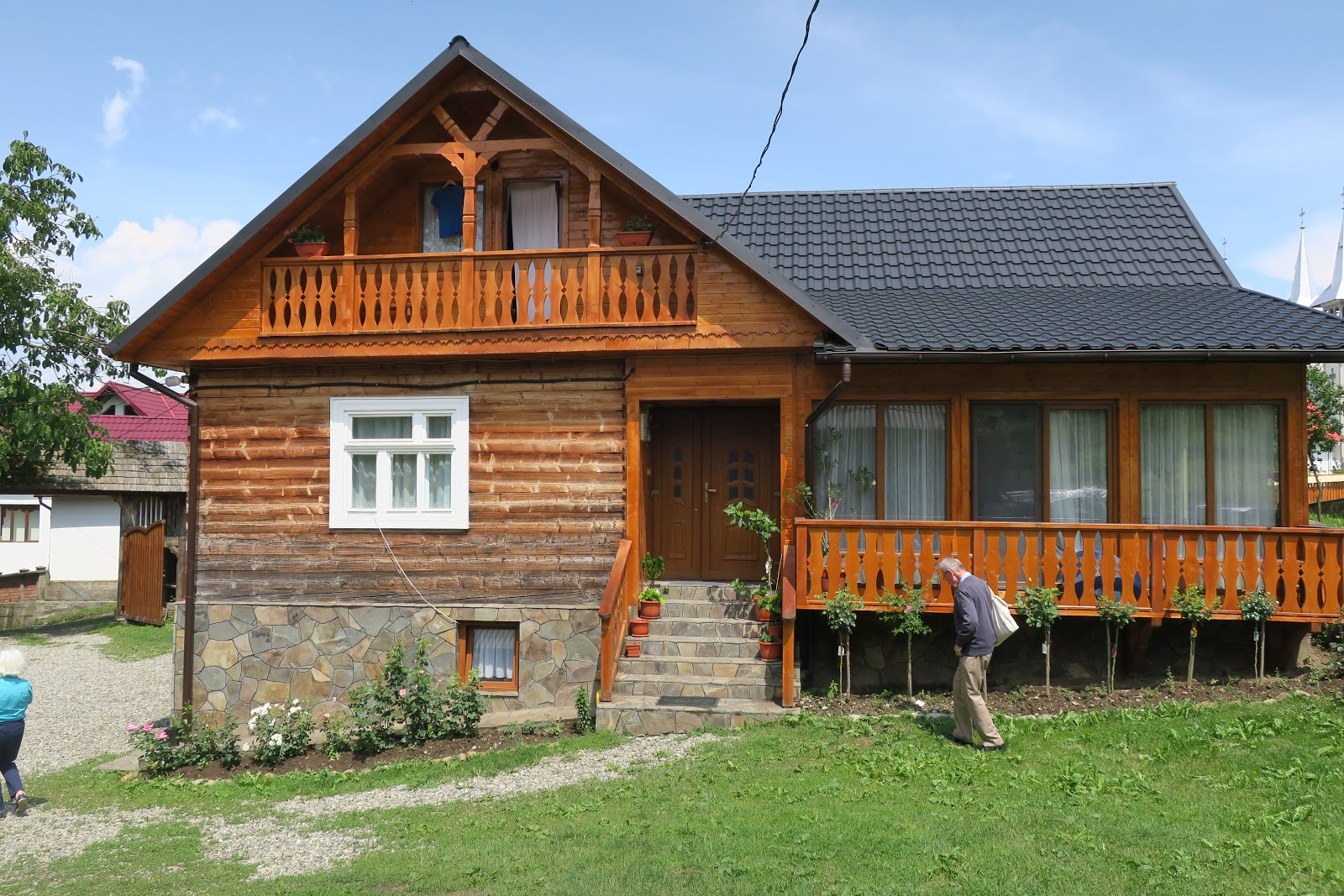
Traditional local houses in Breb
The traditional houses of
Targu Lapus and the Lapusului Country are carved from memory and oak,
standing as quiet witnesses to centuries of rural life in Maramures.
-
These homes are typically built from hand-hewn logs, joined without
nails, and rest on stone foundations that lift them from the damp
earth. Their steep shingled roofs, often adorned with wooden crosses
or sun motifs, echo the region's spiritual and solar symbolism. The
facades are decorated with intricate wood carvings—spirals, rosettes,
and rope motifs—each a protective charm or ancestral sign. The front
gate, often monumental and arched, serves not only as an entrance but
as a threshold between the sacred space of the household and the outer
world.
-
Inside, the layout is both practical and ceremonial. The central room,
or casa mare, is reserved for guests and important rituals, with woven
textiles, icons, and a carved wooden bed that may remain unused except
for special occasions. The hearth is the heart of the home, where
food, stories, and blessings are shared. Many houses include a summer
kitchen and a pantry for preserving smoked meats, pickles, and fruit
preserves. These dwellings are not merely shelters—they are
cosmological diagrams, rooted in the land and aligned with the cycles
of work, worship, and weather. In places like Fantanele or Rogoz, some
of these homes have been lovingly restored, offering visitors a
glimpse into a world where architecture is both craft and prayer.
|
|
Entering the house for lunch
|
|
Lunch table waiting for guests
The cuisine of Targu Lapus
and the Lapusului Country in Maramures is a living archive of ancestral
taste, shaped by Romanian, Hungarian, and Ukrainian influences.
-
Meals are hearty, seasonal, and deeply tied to the rhythms of rural
life. Sarmale—cabbage rolls filled with minced pork and rice—are a
staple at festive tables, often served with mamaliga, a golden
cornmeal porridge similar to polenta. Soups like ciorba de burta
(tripe soup) and zama (clear broth with vegetables and noodles) are
common, especially on Sundays or after long days of fieldwork. Locally
made sausages, smoked meats, and sheep cheeses round out the diet,
offering both nourishment and symbolic hospitality.
-
In Lapusului Country, culinary tradition is preserved with reverence.
Dishes like balmos—a rich mix of sheep cheese, butter, and
mamaliga—are served in wooden bowls, echoing the pastoral roots of the
region. Gomboti, plum dumplings rolled in breadcrumbs and sugar, mark
the sweetness of autumn harvests. Bread is often baked in clay ovens,
and meals are accompanied by pickled vegetables, wild mushroom stews,
and herbal teas. Eating here is not just sustenance—it is ritual,
memory, and transmission. Guests are expected to honor the food by
finishing what is served, a gesture of respect toward the host and the
land itself.
|
|
Lunch with with blueberry liqueur and plum brandy
In Targu
Lapus and the wider Lapusului Country of Maramures, blueberry liqueur is
more than a drink—it is a seasonal ritual, a distillation of forest
memory.
-
Crafted from wild blueberries gathered in the high grasslands and
foothills of Northern Transylvania, this liqueur carries the scent of
moss, pine, and late summer sun. Local producers often follow
ancestral recipes, macerating the berries in spring water before
blending them with distilled alcohol to create a sweet, healing syrup.
The result is a vivid, purple-blue elixir with fruity notes and a
gentle sourness, traditionally served in small doses to lift the
spirit or mark a quiet celebration.
-
Plum brandy, known as tuica, is the soul of Romanian rural
hospitality, and in Lapusului Country it holds ceremonial weight. Made
exclusively from fermented plums, tuica is distilled in copper stills
and aged in wooden barrels, often with carved symbols or interlocking
sticks that reflect Maramures craftsmanship. Its alcohol content
ranges from 40 to 55 percent, and its flavor is rich, fiery, and
deeply rooted in the land. Families pass down their own methods of
fermentation and distillation, treating tuica as both medicine and
offering. It is served before meals, at weddings, funerals, and
harvest gatherings—an emblem of continuity, resilience, and the sacred
bond between fruit, fire, and community.
|
See Also
Source
Location