The Church of St. Nicholas was built in 1530 by Prince Petru Rares and stands
as a significant example of Moldavian ecclesiastical architecture.
It is part of the group of Painted Churches of Northern Moldavia, which were
included in the UNESCO World Heritage list in 1993. The church was constructed
as a burial place for the founder and his family, and it reflects both the
spiritual aspirations and the artistic achievements of the time. Its structure
combines Byzantine and Gothic elements, with a harmonious layout that supports
its rich decorative program.
The interior of the church is renowned for its frescoes, which were completed
in 1532 and are considered among the finest in Moldavia. These paintings cover
the walls with scenes from the Bible, the lives of saints, and symbolic
representations of Christian teachings. Despite the passage of time, the
interior frescoes have retained much of their original vibrancy and detail,
showcasing the skill of the artists and the depth of theological thought
behind the compositions. The altar features a unique iconographic element—the
depiction of the sacrifice of Jesus during the proscomidia—which is rarely
found in Orthodox churches.
Although the exterior frescoes have suffered from weathering and are now
faded, the church remains a powerful testament to the religious and cultural
life of sixteenth-century Moldavia. Restoration efforts carried out between
1996 and 2000 helped preserve the structure and its artwork, ensuring that
future generations can continue to appreciate its historical and spiritual
significance. The Church of St. Nicholas at Probota Monastery stands not only
as a place of worship but also as a monument to the enduring legacy of
Orthodox faith and Romanian artistic heritage.
|
Fortress-like outer walls of Probota Monastery
The outer
walls of Probota Monastery in Romania are massive and fortress-like,
built to protect the monastic complex during the 16th century.
-
Erected under the rule of Petru Rares in 1530, these defensive walls
enclose the church, abbot's house, princely residences, and bell
tower, forming a secure compound typical of Moldavian civil
architecture.
-
Their robust construction reflects the turbulent times and the need
for spiritual sanctuaries to double as strongholds.
-
The walls are punctuated by towers that enhance their defensive
capabilities, and they remain among the few well-preserved examples of
medieval monastic fortifications in the region.
|
|
Monastery gate
In Orthodox Christianity, the monastery gate
is a deeply symbolic threshold between the secular world and the sacred
realm of spiritual devotion.
-
It marks the point where one leaves behind worldly distractions and
enters a space dedicated to prayer, asceticism, and communion with
God. This transition is not only physical but spiritual, echoing
biblical references to gates as passages to holiness and salvation.
The gate serves as a reminder of humility and reverence, preparing the
soul for the sacred experience within the monastery walls.
-
Beyond its symbolic role, the gate also functions as a place of
welcome and spiritual encounter. In Orthodox tradition, hospitality is
a sacred duty, and the gate becomes the first point of contact between
the monastic community and the outside world. It is where monks may
greet pilgrims, offer blessings, and extend kindness to strangers,
reflecting the belief that every visitor could be Christ in disguise.
Thus, the gate embodies both separation and connection, guarding the
sanctity of the monastery while inviting seekers into its spiritual
embrace.
-
the gatehouse is a striking feature of the fortified complex built in
the 16th century. It includes a vaulted passage and often a small
chapel above, reinforcing its role as a spiritual checkpoint. Passing
through this gate, visitors symbolically leave behind the concerns of
daily life and enter a space of contemplation and divine presence. Its
design reflects both the need for protection during turbulent times
and the Orthodox emphasis on spiritual transformation through sacred
thresholds.
|
|
St. Nicholas Church seen from the northwest
The north wall
of the Church of St. Nicholas is part of the exterior ensemble of
frescoes that once adorned the entire church.
-
Painted in 1532, these frescoes were created during the reign of
Prince Petru Rares and reflect the rich artistic tradition of
Moldavian religious art. Although many of the exterior paintings have
faded over time due to exposure to the elements, fragments of the
original compositions can still be discerned. The north wall, like the
others, was designed to convey biblical narratives and theological
themes to the faithful, serving both decorative and didactic purposes.
-
Among the remnants on the north wall are portions of the Akathist Hymn
and the Jesse Tree, which illustrate the lineage of Christ and the
veneration of the Virgin Mary. These elements were part of a broader
iconographic program that covered the church's exterior, making it a
visual catechism for worshippers. Despite the deterioration, the wall
retains traces of its former vibrancy and complexity, offering insight
into the spiritual and artistic aspirations of the time. Restoration
efforts supported by UNESCO have helped preserve what remains,
allowing visitors to appreciate the historical and cultural
significance of this sacred site.
|
|
Plate bell
The Church of St. Nicholas features a distinctive
bell made from a metal plate, a traditional element in Eastern Orthodox
monastic settings.
-
Unlike typical hanging bells, this flat metal plate is struck with a
mallet to produce a resonant sound that calls monks and visitors to
prayer or signals important moments in the liturgical day.
-
Its use reflects ancient practices where simplicity and durability
were valued, especially in remote or fortified monasteries.
-
The sound of the plate bell carries through the compound, serving both
practical and spiritual purposes by marking sacred time and
reinforcing the rhythm of monastic life.
|
|
Wooden board bell
At the Church of St. Nicholas, a
traditional wooden board bell known as a semantron is used to
call the faithful to prayer and mark liturgical moments.
-
This ancient instrument, made from a long plank of wood, is struck
rhythmically with a mallet to produce deep, resonant sounds that carry
across the monastic grounds.
-
The semantron predates metal bells in Orthodox tradition and
symbolizes the voice of the church, inviting spiritual reflection and
communal worship.
-
Its presence at Probota reflects the continuity of monastic customs
and the enduring simplicity of Orthodox liturgical life.
|
|
South wall
The south wall of the Church of St. Nicholas is
part of the renowned ensemble of frescoes that make the site one of the
most significant painted churches in Moldavia.
-
Though many of the exterior paintings have faded over time due to
exposure to the elements, the south wall still retains fragments of
its original decoration. These include scenes from the Akathist Hymn
and the Tree of Jesse, which were common themes in Moldavian church
art during the 16th century. The placement of these images on the
outer wall served both didactic and devotional purposes, allowing
pilgrims and passersby to engage with biblical narratives and
theological symbolism even before entering the church.
-
Inside the church, the south wall continues the visual storytelling
with vivid frescoes that depict biblical scenes, saints, and moments
from the life of Christ. These paintings were completed around 1532,
shortly after the church's construction under Prince Petru Rares. The
artistic style reflects Byzantine influences blended with local
traditions, characterized by expressive figures, rich colors, and
detailed compositions. The south wall, like the rest of the interior,
contributes to the immersive spiritual atmosphere of the church,
guiding worshippers through a visual journey of salvation history and
reinforcing the sacred function of the space.
|
|
Church seen from the southeast
The exterior wall of the nave
at the east end of the Church of St. Nicholas at Probota Monastery is
part of the celebrated ensemble of painted surfaces that once adorned
the entire church.
-
Although many of the frescoes have suffered from exposure to weather
over the centuries, the east end retains traces of its original
decoration. This wall traditionally features scenes related to the
Resurrection and the Last Judgment, themes that are central to
Orthodox theology and often placed on the eastern side of churches to
align with the rising sun and the symbolism of renewal and divine
light. The placement of these images was intended to inspire
reflection and spiritual awakening among those approaching the
sanctuary.
-
The frescoes on the east end of the nave were executed in the early
1530s, shortly after the church's construction under Prince Petru
Rares. They reflect the Moldavian style of painting, which blends
Byzantine iconography with local artistic traditions. Figures are
rendered with expressive gestures and vivid colors, and the
compositions are designed to convey theological narratives in a clear
and engaging manner. Even in their weathered state, the paintings on
the east wall continue to evoke the spiritual atmosphere of the church
and serve as a testament to the rich religious and artistic heritage
of the region.
|
|
Vaulted ceiling of the church portico
The portico vault of
the Church of St. Nicholas features a remarkable and unusual fresco
arrangement that sets it apart from other painted churches in Bukovina.
-
At the center of the vault is a depiction of the Father, enthroned in
majesty, surrounded by celestial imagery that emphasizes divine
authority and cosmic order. Flanking the Father on each side are the
twelve signs of the Zodiac, rendered with symbolic detail and arranged
in a circular rhythm that evokes the passage of time and the harmony
of creation. This celestial row serves not only as decoration but also
as a theological statement, linking the divine with the structure of
the universe and the unfolding of human history.
-
In most other churches of Bukovina, this row of Zodiac signs and the
image of the Father is typically placed at the top of the wall that
contains the Last Judgment scene, reinforcing the idea of divine
oversight and cosmic justice. However, at Probota, this iconographic
sequence is uniquely positioned on the portico vault itself, giving it
a more prominent and immersive role in the viewer's experience. This
placement invites reflection as one enters the sacred space,
suggesting that all who pass beneath it are stepping into a realm
governed by divine order and eternal truths. The artistic choice
reflects both theological depth and creative innovation, making the
portico vault a key feature of the church's spiritual and visual
narrative.
|
|
Panorama of the Last Judgment on the east wall of the church
portico
The Last Judgment in Orthodox Christianity represents the final
and eternal judgment by Christ of all humanity.
-
It is a central eschatological belief that emphasizes divine justice,
mercy, and the ultimate triumph of good over evil. The icon of the
Last Judgment is not merely a depiction of future events but a
spiritual reminder of the moral choices each person must make. It
calls believers to repentance, humility, and vigilance, urging them to
live in accordance with the teachings of Christ. The image typically
includes Christ enthroned in glory, surrounded by angels, saints, and
the righteous, while the damned are shown descending into torment,
symbolizing the consequences of sin and separation from God.
-
Spiritually, the Last Judgment fresco serves as a visual theology that
encapsulates the entire Christian narrative—from creation to
redemption and final reckoning. It is often placed in a prominent
location within churches to confront worshippers with the reality of
divine judgment and the hope of salvation. The fresco is not meant to
instill fear but to inspire transformation and a deeper commitment to
spiritual life. It reflects the Orthodox understanding that salvation
is both a gift and a responsibility, and that every soul will
ultimately stand before Christ to account for its deeds.
-
At the Church of St. Nicholas in the Probota Monastery, the Last
Judgment is painted on the east wall of the portico, a placement that
differs from other Bukovina churches where it is usually found on the
west wall of the church. This fresco presents a vivid and detailed
vision of the final judgment, with Christ at the center, flanked by
angels and saints, and the souls of the righteous and the damned
moving toward their eternal destinies. The composition is rich in
symbolism, including scenes of resurrection, the weighing of souls,
and the separation of the saved from the condemned. Its location on
the east wall of the portico aligns with the rising sun, reinforcing
themes of resurrection and divine illumination.
|
|
Panorama of the entire Last Judgment, including the portico vault
|
|
Diagram of the Last Judgment
Diagram Legend:
- Father
- Zodiac
- Christ in glory (Deisis)
- Empty throne (Etimasia)
- Scale for weighing souls
- Weighing of souls
- River of fire
- Resurrection of the dead from earth
- Resurrection of the dead from the sea
- David playing a stringed instrument
- Peter leading the elect toward Paradise
|
|
Nave of the church
The nave in Orthodox Christianity holds
deep symbolic and spiritual meaning as the central space where the
faithful gather for communal worship.
-
It represents the earthly realm, positioned between the narthex, which
symbolizes the world outside, and the sanctuary, which signifies
heaven. This architectural arrangement reflects the spiritual journey
of believers, who move from the secular world toward divine communion.
The nave is often referred to as the ship of salvation, guiding the
congregation through the spiritual waters of life toward the kingdom
of God. Its openness and orientation toward the altar emphasize unity,
reverence, and the shared experience of liturgical life.
-
Spiritually, the nave serves as a place of transformation and
encounter with the divine. It is where the laity participate in the
sacraments, hear the Gospel, and engage in prayer and veneration. The
iconostasis at the front of the nave, separating it from the
sanctuary, acts as a visual and theological bridge between heaven and
earth, adorned with icons that invite contemplation and connection
with the saints. The nave's design, often enriched with murals and
sacred imagery, reinforces the idea that the church is not just a
building but a living space where heaven touches earth and the
faithful are drawn into the mystery of God's presence.
-
In the Church of St. Nicholas, the nave is a richly decorated and
spiritually charged space that reflects the theological and artistic
traditions of 16th-century Moldavia. Its walls are adorned with
frescoes depicting scenes from the life of Christ, the Virgin Mary,
and various saints, creating an immersive environment for worship and
reflection. The layout of the nave, with its orientation toward the
altar and its integration with the iconostasis, guides the faithful in
their liturgical journey. This sacred space embodies the monastery's
role as a place of prayer, teaching, and spiritual renewal, preserving
centuries of Orthodox devotion and artistic heritage.
|
|
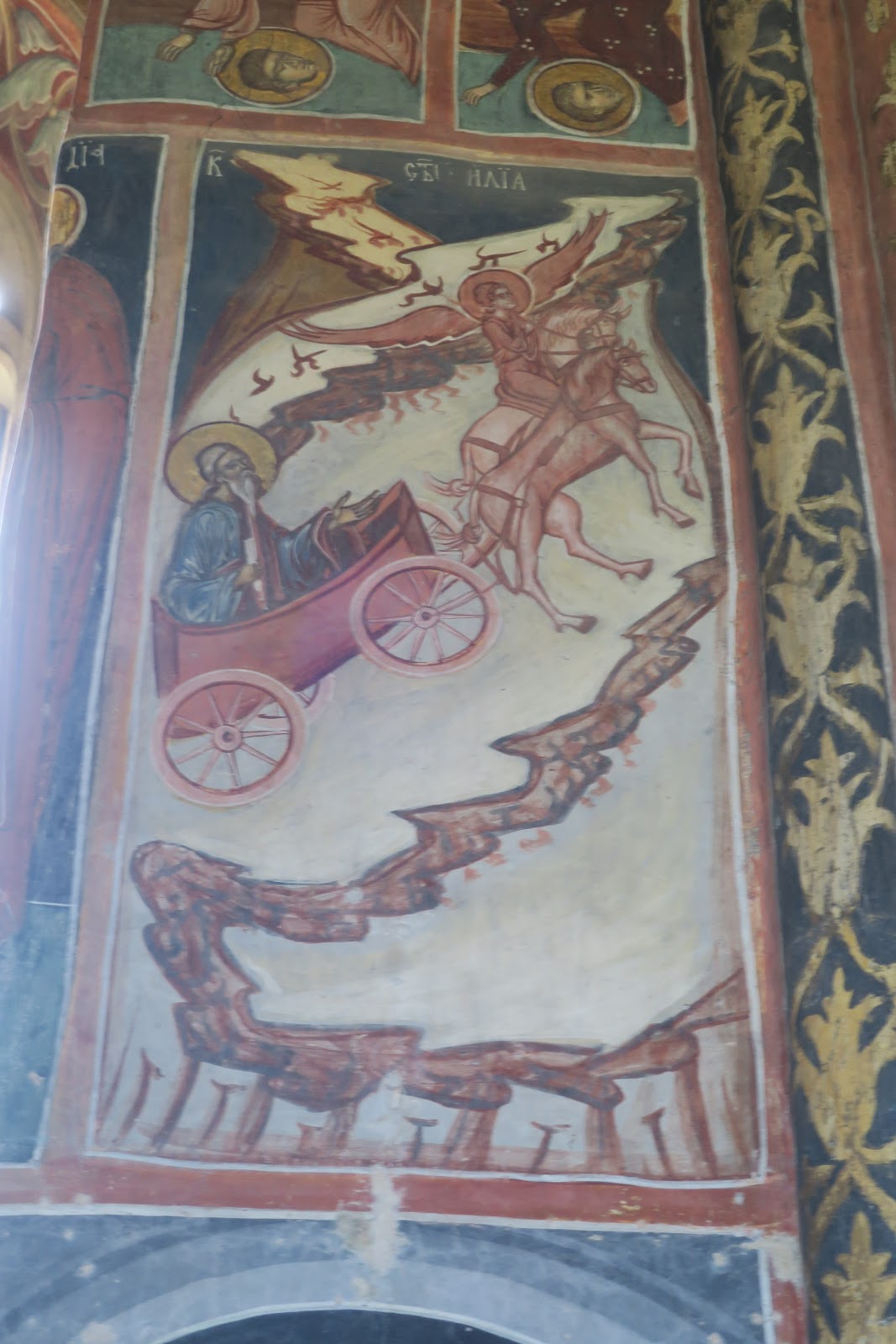
Elijah's Ascent to Heaven
Elijah's Ascent to Heaven in
Orthodox Christianity is a powerful symbol of divine favor, spiritual
elevation, and the mystery of life beyond death.
-
Taken up in a fiery chariot, Elijah is one of the few biblical figures
who does not experience death, which signifies his exceptional
holiness and closeness to God. His ascent is seen as a foreshadowing
of Christ's Ascension and a promise of resurrection for the faithful.
It also reflects the belief that those who live in righteousness may
be lifted into divine presence, transcending earthly limitations
through grace and spiritual purity.
-
Elijah is also revered as a prophet who stood firmly against idolatry
and injustice, making his ascent a reward for his unwavering
commitment to God's truth. In Orthodox tradition, he is a model of
asceticism and prophetic courage, often associated with monastic
ideals. His fiery chariot represents divine energy and the
transformative power of God's will. The story encourages believers to
persevere in faith and reminds them that spiritual struggle leads to
divine union and eternal life.
-
In the Church of St. Nicholas, the fresco of Elijah's Ascent is a
vivid and dramatic portrayal of this sacred event. The prophet is
shown rising in a chariot of fire, surrounded by flames and celestial
figures, capturing the moment of divine elevation with striking color
and movement. Positioned among other biblical scenes, this image
reinforces the church's role as a space for spiritual reflection and
theological teaching. It invites worshippers to contemplate the
mystery of divine ascent and the hope of eternal communion with God.
|
|
Pentecost
Pentecost in Orthodox Christianity is a profound
spiritual event that marks the descent of the Holy Spirit upon the
apostles, fifty days after the Resurrection of Christ.
-
It is considered the birth of the Church, when the apostles were
empowered to preach the Gospel to all nations. The event fulfills
Christ's promise to send the Comforter and reveals the fullness of the
Holy Trinity. The Holy Spirit, appearing as tongues of fire,
symbolizes divine illumination, transformation, and the sanctification
of humanity. Pentecost is celebrated as a feast of unity, mission, and
spiritual renewal, reminding believers of their calling to live in
communion with God and one another.
-
Theologically, Pentecost emphasizes the universality of salvation and
the dynamic presence of the Holy Spirit in the life of the Church. It
affirms that the Spirit continues to guide, inspire, and sanctify the
faithful, making the Church a living body of Christ. The icon of
Pentecost often shows the apostles seated in harmony, with the Holy
Spirit descending as a dove or flame, and a symbolic figure of the
world below them, representing the nations awaiting the message of
salvation. This imagery teaches that the Church is called to bring
light to the world, and that each believer is invited to receive the
Spirit and participate in the divine life.
-
In the Church of St. Nicholas, the fresco of Pentecost captures this
sacred moment with vivid detail and theological depth. The apostles
are shown seated in a semicircle under an arch, with the radiant Holy
Spirit descending from above. Their expressions and gestures convey
reverence and readiness, while the architectural setting emphasizes
the sanctity of the event. This portrayal reflects the Moldavian
artistic tradition and reinforces the monastery's role as a place of
spiritual teaching and divine encounter. It invites worshippers to
contemplate the mystery of the Spirit and their own place in the
mission of the Church.
|
|
Three Warrior Saints
Warrior Saints in Orthodox Christianity
symbolize the union of spiritual strength and earthly courage.
-
Though many were soldiers in life, their sainthood comes from their
martyrdom and unwavering faith in Christ. They are revered not for
their military exploits but for their willingness to suffer and die
for the truth of the Gospel. Their armor and weapons, often depicted
in icons, are not signs of violence but of spiritual readiness,
representing the Christian's battle against sin, temptation, and evil.
These saints are seen as protectors of the Church and intercessors for
the faithful, embodying the virtues of bravery, loyalty, and divine
justice.
-
Spiritually, the Warrior Saints serve as models of vigilance and
sacrifice. Their presence in Orthodox iconography reminds believers
that holiness is not confined to monastic life but can be found in
every vocation, even in the midst of conflict. They stand as witnesses
to the power of faith to transform suffering into sanctity. Their
images, often placed prominently in churches, inspire the faithful to
remain steadfast in trials and to trust in divine protection. The
visual language of their icons—armor, swords, shields—speaks to the
inner struggle of the soul and the call to live with integrity and
courage.
-
In the Church of St. Nicholas, the nave is surrounded by frescoes of
Warrior Saints, each depicted in ornate armor and bearing weapons that
symbolize their spiritual mission. Figures such as Saint George, Saint
Demetrius, and others stand in solemn contemplation, often gazing
toward Christ or the Holy Spirit. Their arrangement around the nave
creates a sense of sacred guardianship, as if the church is encircled
by heavenly defenders. This visual ensemble reflects the Moldavian
tradition of mural painting, blending theological depth with artistic
richness, and invites worshippers to see themselves as part of the
same spiritual struggle and divine protection.
|
|
Saint George (left) and Saint Demetrius (center) contemplating Jesus
Christ
Saint George and Saint Demetrius are revered in Orthodox
Christianity as powerful symbols of faith, courage, and divine
protection.
-
Saint George, known as the Victory-Bearer, is celebrated for his
unwavering commitment to Christ, even unto martyrdom. His image, often
shown in armor and mounted on a horse slaying a dragon, represents the
triumph of good over evil and the spiritual battle every Christian
must face. He is invoked as a protector of cities, soldiers, and the
faithful, and his feast day is marked with prayers for strength and
deliverance. Saint Demetrius of Thessalonica, likewise, is honored as
a martyr and military saint who defended the Christian faith during
times of persecution. His legacy includes miraculous interventions in
battles and healing, and he is seen as a guardian of the Church and a
model of steadfast devotion.
-
Spiritually, both saints embody the Orthodox ideal of the warrior for
Christ—those who fight not with hatred but with love, truth, and
sacrifice. Their presence in icons and frescoes serves to inspire
believers to remain firm in their convictions and to trust in divine
aid during trials. When depicted together, Saint George and Saint
Demetrius often exchange a glance or gesture that reflects unity in
purpose and shared contemplation of Christ. This visual dialogue
between them reinforces their role as intercessors and spiritual
brothers, standing before the Lord in prayer and vigilance. Their
armor and weapons are not merely symbols of war but of spiritual
readiness and the defense of faith.
-
In the Church of Saint Nicholas, Saint George and Saint Demetrius are
depicted side by side in a striking fresco that captures their
contemplative posture toward Jesus Christ. Saint George, on the left,
is shown in armor with his right hand raised in a gesture of
intercession, while Saint Demetrius, in the center, mirrors his stance
with a sword at his side. The two saints appear to be exchanging a
glance, united in their devotion and spiritual mission. A third
military saint stands to the right, possibly Saint Procopius or Saint
Theodore, completing the trio of defenders of the faith. The
inscriptions near their halos confirm their identities, and the
composition reflects the Moldovan tradition of mural painting, rich in
color and theological meaning. This portrayal invites worshippers to
reflect on the courage and holiness of those who serve Christ with
both heart and strength.
|
|
Archangel Michael (left), Archangel Gabriel (center), and the Mother
of God (right)
Archangel Michael, Archangel Gabriel, and the Mother of God each
carry deep symbolic and spiritual meaning in Orthodox Christianity.
-
Archangel Michael is honored as the leader of the heavenly hosts and
the protector of the faithful. He is often depicted in armor, wielding
a sword or spear, symbolizing divine justice and the triumph of good
over evil. His role in the Last Judgment and his presence in prayers
for protection reflect his status as a guardian of souls and defender
of the Church.
-
Archangel Gabriel, by contrast, is the messenger of God, known for
announcing the birth of Christ to the Virgin Mary. He represents
divine communication, purity, and obedience to God's will, often shown
holding a scroll or a lily to signify his role in revealing sacred
truths.
-
The Mother of God, or Theotokos, holds a unique place in Orthodox
theology as the one who bore Christ, making her the bridge between
humanity and divinity. She is venerated not only for her role in the
Incarnation but also for her ongoing intercession on behalf of the
faithful. Her image is often serene and prayerful, symbolizing
humility, compassion, and spiritual motherhood. She is seen as the
most exalted of all saints, and her presence in icons and liturgical
life reflects the Orthodox emphasis on her closeness to Christ and her
care for the Church. Together, these three figures embody protection,
revelation, and mercy, guiding believers in their spiritual journey.
-
In the Church of St. Nicholas, these figures are depicted in a
striking fresco that showcases the Moldovan style of mural painting.
Archangel Michael stands on the left in full armor, symbolizing divine
strength. Archangel Gabriel is in the center, holding a scroll that
suggests a message from God. The Mother of God appears on the right,
also holding a scroll, possibly representing her intercessory prayer
or prophetic role. The Old Church Slavonic inscriptions beside their
halos confirm their identities and reinforce their sacred presence.
This trio forms a powerful visual and theological statement, welcoming
worshippers into a space of divine protection, revelation, and grace.
|
|
Saint Athenaios (left), Saint Nicetas (center) and Saint Callinicus
(right)
|
|
Saint Nicholas and Saint Athenaios
Saint Nicholas holds
profound symbolic and spiritual significance in Orthodox Christianity,
revered as a model of humility, generosity, and unwavering faith.
-
As Bishop of Myra, he became known for his acts of mercy and
protection, especially toward children, the poor, and the oppressed.
His life reflects the Gospel lived through action, embodying the
Christian call to love and serve others selflessly. Orthodox believers
see him not only as a historical figure but as a living intercessor,
whose presence continues to inspire compassion and spiritual devotion.
-
His legacy in Orthodox tradition emphasizes the virtues of kindness
and justice. Saint Nicholas is often portrayed as a defender of truth,
a miracle worker, and a guardian of the faithful. His feast day,
celebrated on December 6, is marked by liturgical services, charitable
acts, and prayers for his intercession. The saint's image, frequently
found in icons, reminds the faithful of God's mercy and the power of
holiness expressed through everyday deeds. His enduring popularity
across Orthodox lands reflects a deep spiritual connection that
transcends time and culture.
-
In Romania, the cult of Saint Nicholas is vibrant and deeply rooted in
both religious practice and folk tradition. He is celebrated as a
bringer of gifts and a moral guide, with customs that blend liturgical
reverence and popular rituals. At the Church of Saint Nicholas in the
Probota Monastery, his patronage is especially significant. The
church, built in the 16th century, is dedicated to him and serves as a
spiritual center where pilgrims honor his memory through prayer and
veneration. His presence there reinforces the monastery's role as a
place of divine protection and moral renewal.
|
|
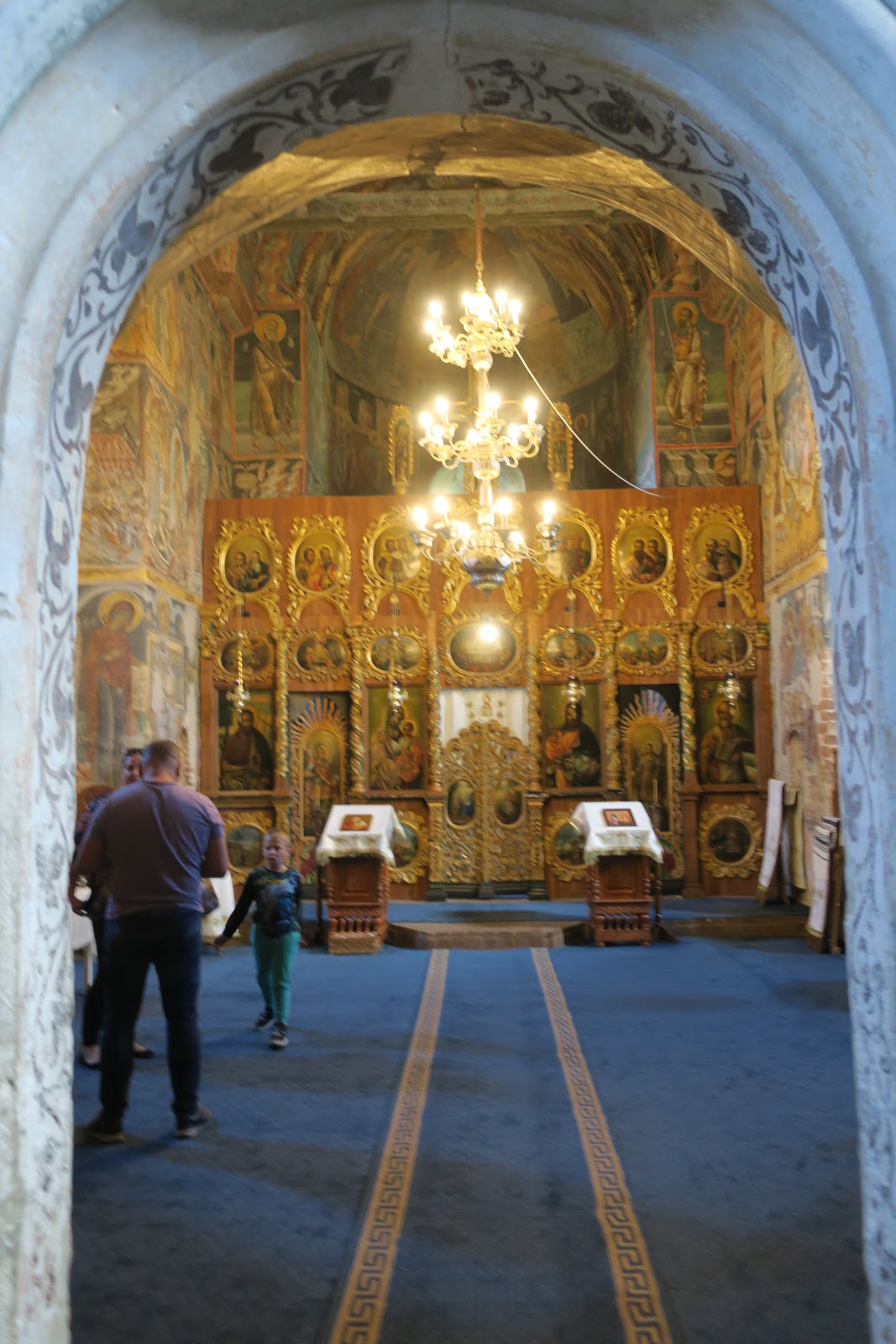
Iconostasis in the nave of the church
The iconostasis in
Orthodox Christianity serves as a sacred partition between the nave and
the sanctuary, symbolizing the boundary between the earthly and the
heavenly realms.
-
It is not merely a physical barrier but a spiritual gateway, adorned
with icons that represent key figures in Christian theology. These
icons are arranged in a hierarchical order, guiding the faithful in
their contemplation and prayer. The iconostasis emphasizes the mystery
of the Eucharist, which takes place behind it, and invites worshippers
to engage with the divine through visual theology.
-
Spiritually, the iconostasis reflects the communion of saints and the
presence of Christ among the faithful. The central Royal Doors,
flanked by two Deacon's Doors, are used during liturgical services and
symbolize access to divine mysteries. The icons surrounding these
doors are not just representations but are considered to be
manifestations of the holy figures they depict. Through this
structure, the church teaches and inspires, offering a glimpse into
the heavenly liturgy and reinforcing the sacred nature of worship.
-
In the Church of St. Nicholas at the Probota Monastery, the
iconostasis is a remarkable example of Moldavian religious art. The
lower level features four main icons: on the far left is St. John the
Baptist, who looks toward Christ; to the left of the Royal Doors is
the Mother of God with the Child Jesus; to the right of the Royal
Doors is Jesus Christ, portrayed as Teacher and Judge; and on the far
right is Saint Nicholas, the patron of the church. These icons are
framed by three doors—the central Royal Doors and two Deacon's
Doors—each playing a role in the liturgical life of the church and
enhancing the spiritual symbolism of the iconostasis.
|
|
Leaving Probota Monastery
|
See Also
Source
Location




 Church of the Dormition of the Virgin Mary, Paiseni Monastery
 Church of Saint George, Saint John the New Monastery