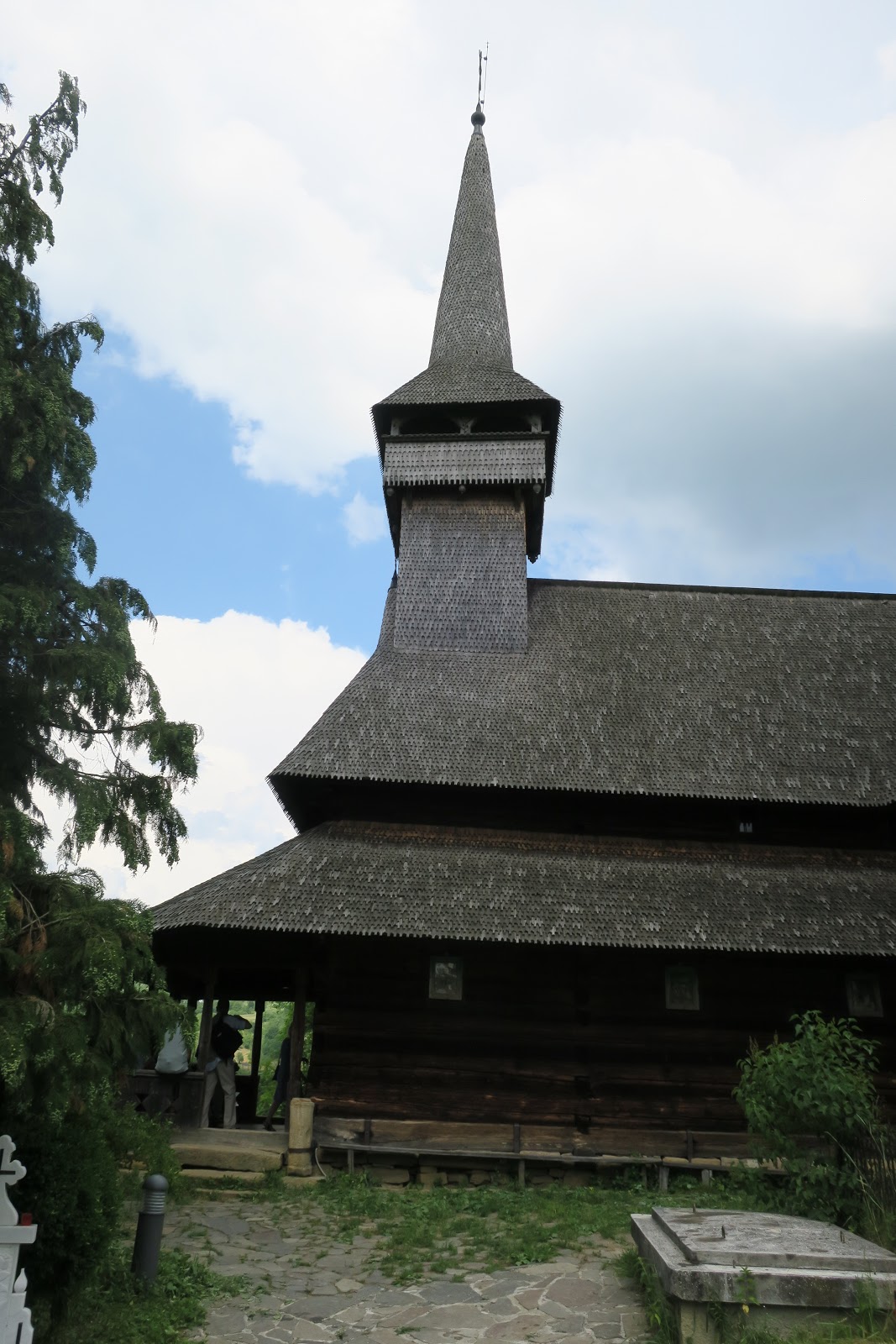
The Wooden Church of Saint Paraschiva in Poienile Izei, Maramures, Romania, is
a remarkable example of traditional wooden ecclesiastical architecture, built
in 1604 and dedicated to Cuvioasa Paraschiva, a beloved Orthodox saint.
Nestled in the Iza Valley, this church is one of the oldest and most
well-preserved wooden churches in the region, and it forms part of the UNESCO
World Heritage Site known as the Wooden Churches of Maramures. Its
construction reflects the deep spiritual life of the local community and their
mastery of timber craftsmanship, using no nails and relying instead on
intricate joinery and wooden pegs.
The church’s structure is modest yet profoundly expressive. It features a
rectangular nave, a recessed altar apse, and a western porch added in the 19th
century. The tall, shingled roof with a double eave and a slender bell tower
rising above the narthex gives the church its iconic silhouette. Inside, the
walls are adorned with vivid frescoes painted in 1794, depicting scenes from
the Old and New Testaments, the Last Judgment, and the lives of saints. These
murals, executed in a naive yet powerful style, serve both as theological
instruction and as a visual catechism for the faithful.
Beyond its architectural and artistic value, the church remains a living place
of worship, deeply woven into the spiritual and communal rhythms of Poienile
Izei. It stands as a testament to the endurance of Orthodox faith and rural
Romanian identity, preserved through centuries of political and cultural
change. The church’s inclusion in the UNESCO list in 1999 not only honors its
historical significance but also ensures its protection for future
generations. Visiting it is not merely a cultural experience—it is a step into
a sacred continuity of prayer, wood, and image.
|
Church seen from the west
|
|
Entering through the east gate
In Orthodox Christianity, the
entrance gate to the church grounds and its surrounding cemetery holds
profound symbolic and spiritual significance.
-
It marks the threshold between the profane world and the sacred
space—a liminal passage where the believer transitions from daily life
into the realm of divine encounter. The gate is often seen as a
metaphor for the narrow path spoken of in Scripture, inviting
humility, repentance, and reverence. Passing through it is not merely
physical but spiritual: one enters into communion with the saints, the
liturgy, and the mystery of death and resurrection. The gate thus
echoes the eschatological hope of the Church, where every entrance
anticipates the final passage into eternal life.
-
The cemetery surrounding the church reinforces this theology. It is
not a place of abandonment but of waiting, a sacred dormitory where
the faithful rest in hope of the resurrection. Graves are oriented
toward the east, symbolizing the rising sun and Christ’s return. The
proximity of the dead to the church affirms the unity of the Church
Militant and Church Triumphant—those living and those who have passed
on, yet remain part of the same liturgical and spiritual body. The
gate, then, is not only an architectural feature but a spiritual
portal, reminding all who enter that they walk among the living and
the dead, in the presence of eternity.
-
At the Wooden Church of Cuvioasa Paraschiva in Poienile Izei,
the entrance gate is a modest wooden structure, often carved with
traditional motifs and flanked by the village cemetery. It embodies
the Maramures ethos of sacred simplicity and deep reverence. As one
passes through, the gate frames the church like a sacred icon,
inviting the pilgrim into a space where time slows and the eternal
becomes palpable. The surrounding graves, many marked with hand-carved
crosses, speak of generations who have prayed, lived, and died in the
shadow of the church. Here, the gate is not just a boundary—it is a
witness to continuity, memory, and the quiet dignity of faith lived
close to the land and close to heaven.
|
|
Saint George Church next door
Saint George, known in
Orthodox Christianity as the Great Martyr and Trophy-Bearer,
embodies the virtues of courage, purity, and unwavering faith.
-
His most iconic representation—slaying the dragon—is not a historical
event but a deeply symbolic image. The dragon represents chaos, evil,
and spiritual deception, while George, mounted on a white horse and
armed with a spear, signifies the triumph of divine grace over
darkness. This iconography is not merely heroic; it is eschatological,
pointing to the victory of Christ through His saints. George’s
martyrdom under Emperor Diocletian further elevates him as a witness
(martyr) to truth, enduring torture and death rather than
renouncing his faith.
-
Spiritually, Saint George is venerated as a protector of the weak, a
liberator of captives, and a healer of the sick. His intercession is
sought in times of danger, especially by soldiers, farmers, and those
facing spiritual battles. In Orthodox hymnography, he is praised as a
noble attendant to kings and a physician of souls,
linking his earthly valor to heavenly service. His feast day,
celebrated on April 23, is marked by processions, prayers, and the
blessing of fields, reflecting his role as a guardian of both the land
and the soul. Saint George’s presence in icons, churches, and
liturgical life serves as a constant reminder that holiness is active,
militant, and victorious.
-
Next to the Wooden Church of Cuvioasa Paraschiva in Poienile
Izei stands the Church of Saint George, a more recent structure that
complements the ancient wooden sanctuary. Though not part of the
UNESCO ensemble, it reflects the continued vitality of Orthodox
worship in the village. Dedicated to the warrior saint, this church
anchors the community’s spiritual resilience, linking the heroic
virtues of Saint George to the everyday struggles of rural life. Its
proximity to the older church creates a dialogue between past and
present, martyrdom and monasticism, reminding pilgrims that the path
of holiness is both ancient and ever-renewing.
|
|
Cemetery and east end of the church
In Orthodox
Christianity, the cemetery surrounding the church is not merely a place
of burial—it is a sacred extension of the liturgical space, a visible
sign of the Church’s eschatological hope.
-
The dead are not considered lost but asleep in Christ, awaiting the
resurrection. Their resting places encircle the church like a living
icon of the communion of saints, affirming the unity between the
Church Militant (the living) and the Church Triumphant (the departed).
This proximity reflects the Orthodox understanding that death is not a
rupture but a passage, and that the prayers of the living continue to
support the souls of the departed.
-
Symbolically, the cemetery is a place of humility and remembrance.
Graves are often oriented toward the east, anticipating the Second
Coming of Christ, who is likened to the rising sun. The presence of
crosses, icons, and flowers reinforces the belief in life after death
and the dignity of every soul. During feast days and memorial
services, families gather at these graves to pray, light candles, and
share food, transforming the cemetery into a space of communion and
continuity. It is a place where sorrow is tempered by hope, and where
the silence of death is filled with the quiet promise of eternal life.
-
At the Wooden Church of Cuvioasa Paraschiva in Poienile Izei,
the surrounding cemetery is intimate and deeply woven into the
spiritual fabric of the village. Modest wooden crosses, often carved
with traditional motifs, mark the graves of generations who lived and
worshipped in the shadow of the church. The cemetery’s closeness to
the sanctuary reflects the Maramures ethos of sacred integration—where
life, death, and liturgy are inseparable. Here, the cemetery is not a
distant field but a sacred garden of memory, where the voices of the
past seem to echo softly through the trees and the prayers of the
present rise gently toward heaven.
|
|
Church entrance door to the west
In Orthodox Christianity,
the entrance door of a church is far more than a functional threshold—it
is a symbolic passage from the fallen world into the sacred realm of
divine encounter.
-
Traditionally placed on the western side of the church, the door marks
the beginning of the spiritual journey, echoing the movement from
darkness to light, from death to resurrection. The west, associated
with the setting sun and the end of earthly life, becomes the point of
entry into the liturgical east, where the altar faces the rising
sun—Christ, the Light of the World. This orientation invites the
faithful to turn their hearts eastward, toward spiritual renewal and
eschatological hope.
-
The entrance door is often adorned with iconography that reinforces
this spiritual transition. Angels, saints, and biblical scenes may be
painted or carved into the doorposts and panels, serving as guardians
and guides. These images are not decorative—they are theological
statements, welcoming the pilgrim and reminding them of the heavenly
hosts who accompany every act of worship. The door thus becomes a
visual catechism, a liminal icon through which one passes into
mystery. It is the first moment of liturgical encounter, where the
visible and invisible worlds begin to converge.
-
At the Wooden Church of Cuvioasa Paraschiva in Poienile Izei,
the entrance door is a striking example of this sacred symbolism.
Positioned on the western façade, it features two angels painted on
the doorposts—one on each side—standing as sentinels of the threshold.
Both doors themselves are also painted, depicting saintly figures that
frame the passage into the nave. Above the doorway, additional
religious images reinforce the sanctity of the entrance. This visual
ensemble transforms the act of entering into a ritual gesture, where
the pilgrim is received not by wood alone, but by a host of spiritual
presences. In this Maramures church, the door is not merely an
architectural element—it is a painted invocation, a gate of reverence,
and a quiet herald of the mysteries within.
|
|
Entering the Pronaos
In Orthodox Christianity, the
pronaos—the entrance chamber or narthex of the church—holds deep
symbolic and spiritual significance.
-
It serves as a transitional space between the secular world and the
sacred interior, where the mysteries of the liturgy unfold.
Historically, the pronaos was the place where catechumens and
penitents stood, not yet fully initiated into the Eucharistic life of
the Church. This architectural threshold reflects the spiritual
journey of purification and preparation, echoing the biblical call to
stand at the door and knock. It is a space of humility,
reflection, and anticipation, where the soul gathers itself before
entering the divine presence.
-
The pronaos also functions as a liturgical and iconographic
prelude. It often contains frescoes of the Last Judgment, saints, and
scenes of repentance, reminding the faithful of the moral and
eschatological dimensions of worship. These images are not merely
decorative—they are pedagogical, guiding the soul toward contrition
and awe. The presence of candles, memorial tables, and commemorative
inscriptions further reinforces the pronaos as a place of
intercession and remembrance. Spiritually, it is the Church’s outer
heart, where the faithful pause, pray, and prepare to cross into the
mystery of divine communion.
-
At the Wooden Church of Cuvioasa Paraschiva in Poienile Izei,
the pronaos is a compact yet richly adorned space, painted in
1794 with vivid scenes of the Last Judgment and moral allegories. It
retains the traditional function of welcoming the faithful into a
state of reverence and reflection. The frescoes, executed in a naive
yet powerful style, depict angels, demons, and the weighing of souls,
inviting the viewer to consider their own spiritual condition. In this
Maramures church, the pronaos is not only an architectural
feature—it is a theological vestibule, where the drama of salvation
begins to unfold in wood, pigment, and silence.
-
Photograph by Țetcu Mircea Rareș, distributed under a CC-BY 4.0
license.
|
|
Christ enthroned in majesty, flanked by apostles
Inside the
pronaos of the Wooden Church of Cuvioasa Paraschiva in
Poienile Izei, a striking mural crowns the entrance door: Christ
enthroned in majesty, flanked by apostles.
-
This composition, painted in 1794, serves as both a theological
proclamation and a liturgical threshold. Christ, depicted with a halo
and regal bearing, holds a scroll or book—symbol of divine wisdom and
judgment. His central placement above the door signifies His role as
the gatekeeper of salvation, the one through whom all must pass to
enter the Kingdom. The apostles, arranged symmetrically on either
side, gaze toward Him or outward, forming a celestial council that
welcomes the faithful into the sacred space.
-
Each apostle is identified by name, written in Cyrillic script above
their heads—Petru, Pavel, Marcu, and
others—affirming their historical and spiritual authority. Their
presence above the western entrance reinforces the idea that the
Church is built upon their witness and teaching. The mural’s placement
in the pronaos, where the Last Judgment is also depicted,
creates a powerful juxtaposition: Christ as judge and Christ as
enthroned teacher. This visual theology invites the pilgrim to reflect
on both mercy and accountability, entering the nave not as a spectator
but as one called to transformation. In this Maramures church, the
mural is not merely decoration—it is a painted liturgy, a silent
sermon in wood and pigment.
-
Photograph by Țetcu Mircea Rareș, distributed under a CC-BY 4.0
license.
|
|
Scenes from Paradise
The mural of Paradise in the Wooden
Church of Cuvioasa Paraschiva in Poienile Izei is a rare and
evocative visual catechism, unfolding across the interior wall with
narrative clarity and theological depth.
-
On the left, the scene of the Father taking Eve from Adam is rendered
with solemn tenderness—Adam reclines, his body echoing the earth,
while Eve emerges from his side, a gesture of divine intimacy and
creative mystery. The Father, often depicted as a majestic figure in
the sky or surrounded by radiant light, blesses the new creation,
establishing the sacred bond between man and woman. This moment is not
only anthropological but eschatological: it prefigures the Church as
the Bride, drawn from the side of the New Adam, Christ.
-
In the center, the drama intensifies. Eve stands with the apple in her
hand, poised before the tree of knowledge, while the serpent coils
around its trunk, whispering temptation. Her gesture is both hesitant
and decisive, capturing the tragic beauty of free will. The tree,
often stylized with symbolic foliage, anchors the scene in cosmic
consequence.
-
To the right, the expulsion from Paradise is depicted with stark
finality—an angel, sword in hand, drives Adam and Eve from the garden.
Their postures are bent, their faces marked by sorrow, and the gate to
Eden closes behind them.
-
This triptych of innocence, fall, and exile is not merely
illustrative—it is liturgical, inviting the viewer to contemplate the
arc of salvation history and the longing for restoration. In this
Maramures church, Paradise is not lost—it is painted as a memory, a
warning, and a promise.
-
Photograph by Țetcu Mircea Rareș, distributed under a CC-BY 4.0
license.
|
|
Scenes from Hell
The mural of Hell in the Wooden Church of
Cuvioasa Paraschiva in Poienile Izei is among the most vivid and
theologically charged depictions in all of Maramures.
-
Painted in 1794, it occupies the right side of the pronaos and
unfolds as a panoramic vision of judgment and torment. Dominating the
composition is the dragon’s head, its jaws wide open, spewing fire
that floods the entire wall. Within its mouth, several condemned
figures are visible—one notably dressed as a cleric or king—suggesting
that no earthly rank exempts one from divine justice. The dragon, a
symbol of chaos and infernal appetite, becomes the gatekeeper of
perdition, swallowing souls who have strayed from the path of
righteousness.
-
Amidst the flames, a demon pushes a handcart filled with ambiguous
objects—perhaps symbols of sin, stolen goods, or the burdens of
unrepented lives. This grotesque procession is surrounded by scenes of
torment: in the upper and lower registers, sinners are subjected to
various punishments by horned and tailed demons. These tortures are
not arbitrary but allegorical, each tailored to a specific vice—greed,
sloth, deceit, or sacrilege. The mural functions as a moral mirror,
warning the viewer of spiritual consequences and urging repentance. In
this Maramures church, Hell is not abstract—it is painted with
terrifying clarity, a visual sermon that burns into memory and
conscience.
-
Photograph by Țetcu Mircea Rareș, distributed under a CC-BY 4.0
license.
|
|
Dragon's head spitting fire from its mouth and nose
The
mural of the dragon’s head in the Hell scene of the Wooden Church of
Cuvioasa Paraschiva in Poienile Izei is one of the most dramatic
and theologically charged images in Romanian Orthodox art.
-
Painted in 1794, the dragon dominates the lower right section of the
pronaos, its mouth and nostrils spewing torrents of fire that
engulf the damned. The flames are not abstract—they are painted with
thick, curling strokes that seem to consume the entire wall, creating
a sense of spiritual suffocation. Inside the dragon’s gaping mouth, a
cleric or king is depicted, his identity marked by a Cyrillic
inscription above his head. His presence signals that even those of
high rank are not immune to divine justice. A demon crouches beside
him, grinning with grotesque satisfaction, reinforcing the idea that
pride, corruption, or hypocrisy among leaders leads to ruin.
-
Above the dragon’s head, the mural continues with scenes of sinners
being punished by demons in various registers. These figures are
painted with expressive agony—some are dragged by their hair, others
are pierced or bound, each punishment tailored to a specific vice. The
demons, horned and tailed, are not just tormentors but allegorical
agents of divine consequence. Their actions reflect the moral order
inverted: where virtue once ruled, now cruelty reigns. This upper
section serves as a visual warning, a theological mirror for the
viewer to examine their own life. In this Maramures church, the dragon
is not a myth—it is a painted truth, roaring across the wall with
fire, judgment, and the echo of eternity.
-
Photograph by Țetcu Mircea Rareș, distributed under a CC-BY 4.0
license.
|
|
Demons plowing open a sinner's body and playing violins over a prone
figure
In the Hell mural of the Wooden Church of
Cuvioasa Paraschiva in Poienile Izei, one of the most haunting
and allegorical scenes depicts demons plowing open the body of a sinner.
-
This grotesque act is not merely punitive—it is symbolic of spiritual
violation and moral exposure. The plow, labeled with inscriptions such
as slander and blasphemy against one's neighbors, cuts
through the prone figure as if tilling the soil of a corrupted soul.
The demons, horned and muscular, perform their task with grim
efficiency, turning the body into a field of consequence. This image
draws from agrarian metaphors familiar to the local community,
transforming the act of cultivation into one of infernal retribution.
It is a visual sermon: what one sows in sin, one reaps in torment.
-
Beside this scene, another demon plays a violin over a burning bed
where a sinner lies in agony. The music, far from soothing, becomes a
mockery of comfort—a twisted lullaby in the theater of damnation. This
detail, both surreal and chilling, suggests that even beauty can be
perverted in Hell, used not to console but to torment. The
juxtaposition of music and suffering evokes the idea that sin distorts
harmony, turning divine gifts into instruments of pain.
-
In this Maramures church, the mural does not merely depict Hell—it
orchestrates it, layering sound, motion, and metaphor into a tableau
of moral reckoning. The viewer is not just warned—they are drawn into
a visceral meditation on the wages of vice.
-
Photographs by Țetcu Mircea Rareș, distributed under a CC-BY 4.0
license.
|
|
Saint George, Saint Demetrius, and Saint Catherine
In
Orthodox Christianity, Saint George, Saint Demetrius, and
Saint Catherine embody three luminous paths of martyrdom: valor,
fidelity, and wisdom.
-
Saint George, the Great Martyr and Trophy-Bearer, is venerated as a
fearless defender of the faith, often shown slaying a dragon—a symbol
of evil and chaos. His martyrdom under Diocletian reveals the triumph
of spiritual courage over imperial violence. Saint Demetrius, the
Myrrh-Gusher of Thessaloniki, complements George as a soldier-saint
who embraced death with serenity, blessing the young Nestor to defeat
the gladiator Lyaeus. His body, said to exude fragrant myrrh, becomes
a symbol of sanctified suffering and divine consolation. Together,
George and Demetrius are seen as heavenly protectors, interceding for
cities, soldiers, and the faithful in times of peril.
-
Saint Catherine of Alexandria represents the intellectual and mystical
dimension of martyrdom. A noblewoman and philosopher, she confronted
pagan scholars with divine wisdom, converting many before enduring
torture and death. Her mystical union with Christ, often depicted as a
heavenly betrothal, elevates her witness beyond argument into
communion. In Orthodox iconography, she holds a wheel (the instrument
of her torture) and a book, symbolizing the fusion of suffering and
divine knowledge. Together, these three saints form a triad of
spiritual excellence: George as the warrior of purity, Demetrius as
the witness of peace, and Catherine as the bride of wisdom. Their
lives are not merely historical—they are liturgical archetypes, woven
into the prayers, icons, and spiritual imagination of the Church.
-
In the Wooden Church of Saint Paraschiva in Poienile Izei, these
saints appear in a painted panel that blends narrative and symbolic
depth. Saint George and Saint Demetrius, dressed in red and military
attire, are shown in a moment of arrest or confrontation—perhaps being
led to martyrdom or standing before imperial judgment. Their calm
expressions and upright postures suggest inner victory, even as
worldly powers press against them. Below or beside them, Saint
Catherine appears among smaller haloed figures, possibly in a posture
of reverent witness or spiritual solidarity. The architectural
backdrop, with arches and red-tiled roofs, anchors the scene in both
heavenly and earthly realms. Painted in 1794 by Gheorghe of
Dragomiresti, this composition transforms martyrdom into a communal
icon of resistance, dignity, and divine intimacy. It invites the
viewer not only to admire but to emulate—to stand firm, speak truth,
and love unto the end.
-
Photograph by Țetcu Mircea Rareș, distributed under a CC-BY 4.0
license.
|
|
Jesus and the Samaritan Woman at Jacob's Well
In Orthodox
Christianity, the encounter between
Jesus and the Samaritan Woman at Jacob’s Well is a luminous icon
of divine condescension, spiritual thirst, and transformative dialogue.
-
Christ, weary from His journey, sits at the well and asks for
water—not because He needs it, but to awaken the woman’s deeper
longing. She comes seeking ordinary water, but receives the revelation
of living water, a symbol of grace, truth, and eternal life.
This moment, recorded in John 4:5–42, is celebrated on the fifth
Sunday after Pascha, known as the
Sunday of the Samaritan Woman. It marks the breaking of social,
religious, and gender barriers: a Jewish rabbi speaks with a Samaritan
woman, revealing that salvation is not confined to place or lineage,
but is offered to all who worship in spirit and truth.
-
Spiritually, the Samaritan Woman—later known in Orthodox tradition as
Saint Photini, Equal-to-the-Apostles—embodies the soul’s
awakening. Her dialogue with Christ moves from skepticism to
recognition, from shame to proclamation. She becomes a missionary,
bringing her village to the Messiah. The well itself becomes a symbol
of the heart: deep, ancient, and waiting to be filled with divine
presence. Orthodox hymnography praises this encounter as a moment of
illumination, where the Word of God draws forth the truth hidden
within the soul. The Church invites the faithful to see themselves in
Photini—to bring their thirst, their questions, and their wounds to
the One who offers water that never runs dry.
-
In the Wooden Church of Saint Paraschiva in Poienile Izei, this scene
is painted with pastoral intimacy and theological depth. Christ sits
on a rock beside the well, haloed and serene, while the Samaritan
Woman stands before Him, gesturing in dialogue. Behind them, a walled
city and distant disciples frame the moment in sacred geography.
Painted in 1794 by Gheorghe of Dragomiresti, the mural captures the
stillness of revelation: the well as center, the figures as mirror,
the landscape as witness. Here, the encounter is not just
remembered—it is re-lived. The viewer is invited to stand beside the
Woman, to listen, to ask, and to receive the living water that flows
from the Word made flesh.
-
Photograph by Țetcu Mircea Rareș, distributed under a CC-BY 4.0
license.
|
|
Parable of the Ten Virgins
In Orthodox Christianity, the
Parable of the Ten Virgins is a profound allegory of vigilance,
spiritual preparedness, and the mystery of the soul’s union with Christ.
-
The ten virgins—five wise and five foolish—represent humanity awaiting
the Bridegroom, who is Christ Himself. The oil in their lamps
symbolizes the inner virtues cultivated through prayer, repentance,
and good deeds. The wise virgins, who bring extra oil, embody those
who live in constant readiness, nourishing their souls with grace. The
foolish ones, who neglect this preparation, are shut out from the
wedding feast, a symbol of the Kingdom of Heaven. This parable is
especially emphasized during Holy Week, where it serves as a call to
awaken from spiritual slumber and prepare for the coming of the Lord.
-
Spiritually, the parable reveals the hidden drama of the heart: the
tension between outward religious form and inward transformation.
Virginity here is not merely physical purity but the soul’s
consecration to God. The midnight cry—Behold, the Bridegroom comes!—is the moment of divine visitation, often interpreted as the Second
Coming or the hour of death. The closed door is not a punishment but a
revelation of truth: that union with Christ cannot be improvised.
Saints like Seraphim of Sarov and Cyril of Alexandria interpret the
oil as the grace of the Holy Spirit, acquired through ascetic struggle
and love. Thus, the parable becomes a mirror for the soul, urging each
person to cultivate watchfulness, humility, and readiness for the
eternal wedding banquet.
-
In the Wooden Church of Saint Paraschiva in Poienile Izei, this
parable is vividly depicted in the lower register of the mural. On the
left side, the ten virgins stand in two groups—five wise and five
foolish—each holding lamps, their garments painted in red and green
tones. Above them, the inscriptions Tosta Dratimpore and
Tosta Dintalore may refer to symbolic or local designations of
the two groups. On the right side, the spiritual marriage unfolds: a
crowned figure, likely Christ as Bridegroom, receives the wise virgins
into the heavenly chamber. This visual theology, painted in 1794 by
Gheorghe of Dragomiresti, transforms the parable into a liturgical
icon—a ritual threshold between earthly vigilance and divine union.
-
Photograph by Țetcu Mircea Rareș, distributed under a CC-BY 4.0
license.
|
|
Parable of Lazarus and the Rich Man
In Orthodox
Christianity, the Parable of Lazarus and the Rich Man is a piercing
revelation of divine justice, spiritual reversal, and the eternal
consequences of earthly choices.
-
Lazarus, the poor beggar covered in sores, is not vindicated merely
for his poverty, but for his humility, patience, and silent trust in
God. The rich man, clothed in luxury and feasting daily, is condemned
not for wealth itself, but for his indifference, his failure to see
and respond to the suffering at his gate. The parable, found in Luke
16:19–31, is not just moral instruction—it is eschatological prophecy.
It unveils the hidden drama of the soul: that what is exalted on earth
may be abased in eternity, and what is despised may be glorified in
the bosom of Abraham.
-
Spiritually, the parable invites the faithful to cultivate compassion,
vigilance, and detachment from worldly excess. It affirms that the
soul’s destiny is shaped not by status but by love. The chasm between
Lazarus and the rich man after death is not arbitrary—it is the
visible form of their invisible choices. In Orthodox tradition, this
story is read as a warning against spiritual blindness and a call to
recognize Christ in the poor, the wounded, and the forgotten. Saints
like John Chrysostom and Gregory the Theologian interpret the parable
as a mirror for the conscience, urging believers to live with mercy
and prepare for the life beyond. It is not a tale of vengeance—it is a
liturgical icon of divine mercy and human responsibility.
-
In the Wooden Church of Saint Paraschiva in Poienile Izei, this
parable is rendered with poignant clarity. In the mural,
Lazarus lies on a bed, frail and passive, while
Christ stands to the left, extending a gesture of blessing or
recognition. The rich man appears on the right, dressed in
ornate robes, his posture suggesting detachment or concern. The
composition, painted in 1794 by Gheorghe of Dragomiresti, captures the
moment of divine judgment and reversal. The bed becomes a threshold
between worlds—between suffering and glory, between neglect and
redemption. This visual theology, embedded in the wooden walls of the
church, transforms the parable into a communal meditation, reminding
every viewer that eternity begins at the gate of compassion.
-
Photograph by Țetcu Mircea Rareș, distributed under a CC-BY 4.0
license.
|
|
Two miracles of Christ
-
Photograph by Țetcu Mircea Rareș, distributed under a CC-BY 4.0
license.
|
|
Christ’s appearance before Pontius Pilate
In Orthodox
Christianity, Christ’s appearance before Pontius Pilate is a moment of
cosmic irony and spiritual revelation.
-
The Judge of all creation stands silently before a mortal governor,
submitting not to Roman authority but to the divine plan of
redemption. Pilate, caught between political pressure and personal
unease, asks What is truth?—a question that echoes through the
centuries. Christ does not answer with argument but with presence; His
silence is not weakness but divine restraint. This trial scene reveals
the contrast between worldly power and heavenly kingship: Pilate sits
on a throne of law, but Christ reigns from the throne of humility. The
Orthodox Church sees this moment as the unveiling of the Lamb who
willingly offers Himself, fulfilling Isaiah’s prophecy of the
suffering servant.
-
Spiritually, this encounter is a mirror for the soul. Pilate
represents the human tendency to evade responsibility, to wash hands
instead of bearing witness. Christ, by contrast, embodies truth that
cannot be silenced. The Orthodox liturgy commemorates this scene
during Holy Week, not to condemn Pilate, but to invite reflection:
where do we stand when truth is on trial? Icons of the moment often
show Christ serene and radiant, while Pilate appears troubled,
surrounded by accusers. The juxtaposition teaches that divine truth is
not defended by force but revealed through sacrifice. Christ’s quiet
dignity before Pilate becomes a model for spiritual courage—truth that
endures mockery, injustice, and death, yet remains unshaken.
-
In the Wooden Church of Saint Paraschiva in Poienile Izei, this scene
is painted with theatrical and theological precision. Christ stands
bound, partially undressed, while Pilate sits in judgment, gesturing
toward the crowd or officials. The figures around Christ—soldiers,
accusers, attendants—form a circle of tension, while His haloed
presence remains calm and luminous. Painted in 1794 by Gheorghe of
Dragomiresti, the mural captures the drama of injustice and the
serenity of divine purpose. The Cyrillic inscription below,
Iis Hrysta Tesalki Slachi Ga, likely refers to Christ being
stripped or handed over, anchoring the scene in liturgical memory.
Here, the trial is not just historical—it is sacramental, inviting
each viewer to discern truth, bear witness, and stand with the One who
reigns through surrender.
-
Photograph by Țetcu Mircea Rareș, distributed under a CC-BY 4.0
license.
|
|
Pilate Washing his Hands
In Orthodox Christianity, Pilate’s
act of washing his hands during Christ’s trial is a symbol of moral
evasion and spiritual blindness.
-
Though he declares himself innocent of Christ’s blood, his gesture
reveals a deeper truth: that neutrality in the face of injustice is
itself a form of complicity. Pilate stands at the threshold of divine
revelation and chooses political safety over truth. His washing of
hands, recorded in Matthew 27:24, becomes a liturgical and ethical
warning—an image of the soul that refuses responsibility, even when
confronted with the Incarnate Word. Unlike the sacramental washing of
baptism, which cleanses through repentance, Pilate’s washing is
sterile, performative, and tragically hollow.
-
Spiritually, this moment exposes the tension between worldly authority
and divine kingship. Pilate, the Roman governor, represents the
empire’s power, yet he is powerless before the mystery of Christ. His
attempt to absolve himself echoes the human tendency to distance
oneself from suffering, to delegate guilt, and to preserve comfort. In
Orthodox hymnography, Pilate’s act is remembered not with condemnation
but with sorrow—a lament for the blindness that chooses expedience
over truth. The Church invites the faithful to contrast Pilate’s
gesture with the courage of the martyrs and the humility of Christ,
who embraces the Cross without protest. Thus, the washing of hands
becomes a mirror: will we wash away responsibility, or will we bear
witness?
-
In the Wooden Church of Saint Paraschiva in Poienile Izei, this scene
is painted with dramatic clarity. Pilate is shown seated, surrounded
by officials and soldiers, while a basin is brought forward and his
hands are ritually washed. The mural, painted in 1794 by Gheorghe of
Dragomiresti, captures the theatrical solemnity of the moment—Pilate’s
gesture is calm, almost detached, while Christ stands nearby, silent
and haloed. The Cyrillic inscription below echoes his declaration of
innocence, anchoring the scene in both Scripture and communal memory.
Here, the act of washing is not cleansing—it is a rupture, a refusal
to enter the mystery. The viewer is invited to contemplate not only
Pilate’s decision but their own: to wash away truth, or to stand with
the Crucified.
-
Photograph by Țetcu Mircea Rareș, distributed under a CC-BY 4.0
license.
|
|
Crowning and Mocking of Christ
In Orthodox Christianity, the
crowning of Christ with thorns and His mocking by Roman soldiers is a
moment of profound paradox: the King of Glory is adorned with a crown of
pain, clothed in ridicule, and enthroned in humiliation.
-
This episode, described in the Gospels of Matthew, Mark, and John,
reveals the depth of Christ’s kenosis—His voluntary self-emptying. The
crown of thorns, twisted and pressed into His brow, becomes a symbol
of both suffering and sovereignty. It fulfills prophecy and exposes
the blindness of worldly power, which mocks what it cannot comprehend.
Spiritually, this act unveils the mystery of divine kingship: Christ
reigns not through domination but through sacrificial love, bearing
the scorn of men to redeem them from within.
-
The mocking of Christ—cloaked in a purple robe, struck, spat upon, and
hailed as King of the Jews—is not merely cruelty; it is the
world’s rejection of holiness. Yet in Orthodox theology, this
rejection becomes the path to transfiguration. The thorns pierce not
only flesh but the veil between heaven and earth. Saints like Maximus
the Confessor interpret this moment as the reversal of Adam’s fall:
where pride once ruled, humility now reigns. The crown of thorns is
thus not a defeat but a hidden coronation, a sign that Christ’s
kingdom is not of this world but for its salvation. In liturgical
hymns, this scene is remembered with awe and reverence, inviting the
faithful to contemplate the mystery of a God who suffers to heal.
-
In the Wooden Church of Saint Paraschiva in Poienile Izei, this scene
is rendered with stark emotional clarity. Christ sits or stands at the
center, surrounded by soldiers and tormentors, some holding staffs or
spears, others gesturing in mock homage. The mural, painted in 1794 by
Gheorghe of Dragomiresti, captures the tension between brutality and
serenity: Christ remains composed, haloed, and luminous, even as the
world heaps scorn upon Him. The Cyrillic inscriptions above and below
frame the scene in sacred narrative, anchoring it in both Scripture
and communal memory. Here, the crown of thorns is not only a
historical detail—it is a theological icon, carved into wood and time,
inviting each viewer to recognize the true King hidden in suffering.
-
Photograph by Țetcu Mircea Rareș, distributed under a CC-BY 4.0
license.
|
|
Christ carrying the cross
In Orthodox Christianity, the
image of Christ carrying the cross is a profound icon of divine
humility, sacrificial love, and the mystery of redemptive suffering.
-
It is not merely a historical moment but a spiritual archetype: the
God-man voluntarily bearing the weight of human sin, shame, and
mortality. This act reveals the paradox of divine strength hidden in
weakness, and the path to glory through self-emptying. The cross is
not imposed—it is embraced. Christ’s journey to Golgotha becomes the
template for every believer’s ascent: a call to take up one’s own
cross daily, not in despair but in communion with the suffering
Savior. The Orthodox tradition sees this moment as the beginning of
the *kenosis*, the self-emptying that culminates in resurrection and
deification.
-
Spiritually, the carrying of the cross is also a liturgical and
mystical reality. It is reenacted in the services of Holy Week,
especially on Holy Friday, where the faithful follow Christ in solemn
procession. Saints like Maximus the Confessor and Isaac the Syrian
interpret this moment as the descent into the depths of human
brokenness, where divine love meets the furthest reaches of
alienation. The cross becomes a ladder, not a burden—a means of ascent
into divine life. In icons, Christ is often shown serene and resolute,
even as He stumbles, emphasizing that this suffering is chosen,
transfigured, and ultimately victorious. Thus, the image is not tragic
but triumphant: the Lamb who bears the world’s wounds and transforms
them into healing.
-
In the Wooden Church of Saint Paraschiva in Poienile Izei, the scene
of Christ carrying the cross is painted on a wooden beam with striking
emotional and architectural depth. Christ is bent under the weight of
the cross, surrounded by Roman soldiers and onlookers, while the
background includes stylized buildings and a church, anchoring the
biblical event in a sacred landscape. The mural, part of the 1794
cycle by Gheorghe of Dragomiresti, fuses post-Byzantine iconography
with local folk elements, making the Passion both universal and
intimate. The wood’s aged texture and the expressive gestures of the
figures evoke a living memory of suffering and hope, inviting the
viewer not only to witness but to participate in the mystery of
redemption.
-
Photographs by Țetcu Mircea Rareș, distributed under a CC-BY 4.0
license.
|
|
Crucifixion and Sharing of Christ’s Garments
In Orthodox
Christianity, the Crucifixion of Christ is the supreme revelation of
divine love and humility.
-
It is not simply a moment of suffering, but the mystical center of
salvation—the voluntary self-offering of the Son of God for the life
of the world. On the Cross, Christ unites heaven and earth, embracing
all human pain and transforming it into a path of resurrection. The
Cross is both altar and throne: a place of sacrifice and a sign of
victory. Orthodox theology sees this moment as the fulfillment of the
Incarnation, where Christ descends into the depths of human brokenness
to redeem it from within. The Crucifixion is celebrated liturgically
with solemn reverence, especially on Holy Friday, and iconographically
it is rendered with serenity and majesty, emphasizing Christ’s divine
composure even in death.
-
The Sharing of Christ’s Garments, often depicted immediately below the
Crucifixion, carries deep prophetic and spiritual meaning. The
seamless tunic, which the soldiers refuse to tear, symbolizes the
unity of the Church and the integrity of Christ’s divine-human nature.
This act fulfills Psalm 22:18—They divided my garments among them, and for my clothing they cast
lots—revealing that even in humiliation, divine providence is at work.
Spiritually, the scene invites reflection on how the world often seeks
to divide what is sacred, while Christ offers wholeness. The soldiers’
indifference contrasts with the reverence of the faithful, reminding
the viewer to approach the mystery of Christ not with casual
detachment but with awe and gratitude. In Orthodox iconography, this
moment is not marginal—it is a theological echo, a quiet commentary on
the drama unfolding above.
-
In the Wooden Church of Saint Paraschiva in Poienile Izei, these two
scenes are painted in a vertical liturgical axis. In the
upper register, the Crucifixion is depicted with Christ on the
Cross, flanked by mourners and witnesses, set against a stylized
landscape that evokes both Golgotha and cosmic sorrow. In the
lower register, the Sharing of Christ’s Garments unfolds with
Roman soldiers casting lots, their gestures animated and expressive.
The juxtaposition of these scenes—painted in 1794 by Gheorghe of
Dragomiresti—creates a visual theology of descent and division: from
divine sacrifice above to worldly fragmentation below. Yet the
seamless garment remains intact, a silent witness to the unity that
Christ preserves even in death. This composition invites the viewer to
ascend spiritually, from the confusion of the world to the clarity of
the Cross.
-
Photograph by Țetcu Mircea Rareș, distributed under a CC-BY 4.0
license.
|
|
Burial of Christ
In Orthodox Christianity, the burial of
Christ is not a moment of defeat but a sacred descent—a passage into the
depths of death to redeem it from within.
-
Celebrated liturgically on Great and Holy Saturday, this event marks
the silence of the tomb, where Christ rests in the flesh while His
soul descends into Hades. This descent is not passive; it is
triumphant. Christ enters the realm of the dead as the living God,
shattering its gates and liberating those held captive. The tomb
becomes a bridal chamber, a place of transformation where mortality is
embraced and transfigured. The burial is thus a prelude to
resurrection, a mystery of divine humility and hidden victory.
-
Spiritually, Christ’s burial invites the faithful into a posture of
watchful stillness. It is the moment between agony and glory, where
hope is held in silence. The Orthodox Church teaches that through
baptism, each believer mystically participates in Christ’s death and
burial, dying to sin and being raised to new life. Icons of the burial
often show the Theotokos, John the Evangelist, and other disciples
mourning with reverence, while angels stand in quiet witness. This
scene is not only historical—it is eschatological. It teaches that
even in death, God is present, active, and victorious. The burial
affirms that no place is beyond the reach of divine love—not even the
grave.
-
In the Wooden Church of Saint Paraschiva in Poienile Izei, the burial
of Christ is depicted with solemn intimacy. The mural shows Christ’s
body laid out on a platform, surrounded by haloed figures—likely the
Virgin Mary, apostles, and holy women—grieving with tenderness and
awe. In the background, three crosses rise, anchoring the scene in the
aftermath of Golgotha. Painted in 1794 by Gheorghe of Dragomiresti,
this image blends post-Byzantine iconography with local folk
sensibility, using expressive gestures and warm tones to evoke both
sorrow and sacred stillness. The Cyrillic inscription frames the
scene, rooting it in liturgical tradition and communal memory. Here,
the burial is not an end—it is a threshold, a quiet promise of the
resurrection to come.
-
Photograph by Țetcu Mircea Rareș, distributed under a CC-BY 4.0
license.
|
|
Resurrection of Christ
In Orthodox Christianity, the
resurrection of Christ is the radiant center of faith, the triumph of
divine life over death, sin, and corruption.
-
It is not merely a historical event but a cosmic renewal—the beginning
of the new creation. Christ rises not as a solitary victor but as the
firstfruits of all humanity, opening the path to resurrection
for every soul. The Paschal hymn
Christ is risen from the dead, trampling down death by death
encapsulates this mystery: death itself is defeated from within. The
resurrection affirms that the Incarnation was not temporary; Christ’s
glorified body is the pledge of our own transfiguration. In Orthodox
theology, this event is celebrated not only on Pascha but every
Sunday, every liturgy, every moment of grace.
-
Spiritually, the resurrection is the gateway to eternal life—not as a
distant reward but as a present communion. Through baptism, Eucharist,
and ascetic struggle, the believer participates in the risen life of
Christ. Icons of the resurrection often depict Christ descending into
Hades, lifting Adam and Eve from their tombs, symbolizing the
liberation of all creation. This descent is not a retreat but a
conquest: Christ enters the realm of death and breaks its gates.
Saints like Gregory of Nyssa and John of Damascus interpret the
resurrection as the restoration of the image of God in humanity, the
healing of the soul’s fragmentation. Thus, resurrection is not
escape—it is return, reunion, and radiant transformation.
-
In the Wooden Church of Saint Paraschiva in Poienile Izei, the
resurrection is depicted with luminous clarity. In the mural, Christ
stands at the center, emerging from the tomb with a red banner of
victory, surrounded by a radiant aura. Roman soldiers lie stunned or
awestruck, while the landscape behind evokes both earthly and heavenly
realms. Painted in 1794 by Gheorghe of Dragomiresti, this scene fuses
post-Byzantine iconography with local folk expression. The Cyrillic
inscription below anchors the image in liturgical tradition, while the
placement above a framed icon suggests a living continuity between
painted theology and devotional practice. Here, resurrection is not
abstract—it is embodied, communal, and ever-present.
-
Photograph by Țetcu Mircea Rareș, distributed under a CC-BY 4.0
license.
|
|
Three Women at the Empty Tomb
In Orthodox Christianity, the
encounter of the Three Women at the Empty Tomb with the angel
announcing the Resurrection is a moment of luminous reversal and sacred
astonishment.
-
These women—Mary Magdalene, Mary the mother of James, and Salome—come
bearing myrrh to anoint the dead, but instead find the tomb open and
the angel proclaiming, He is not here; He is risen. Their
faithful love, expressed through ritual care, is rewarded with the
first revelation of Paschal joy. This scene, commemorated on the
Sunday of the Myrrhbearers, affirms that those who seek Christ
in humility and devotion become the first witnesses of divine glory.
The angel’s message is not just information—it is transformation,
turning grief into proclamation and silence into song.
-
Spiritually, the Myrrhbearing Women represent the soul’s journey from
sorrow to resurrection. They approach the tomb expecting death, but
encounter life. Their fear and confusion mirror the human condition,
while their response—running to tell the disciples—models the Church’s
mission. In Orthodox iconography, the angel is often seated on the
stone, serene and radiant, while the women bow in awe, their gestures
frozen between reverence and wonder. This moment is not passive—it is
the beginning of apostolic witness. The Orthodox tradition honors
these women not only for their courage but for their theological
insight: they recognize the empty tomb not as absence, but as
presence, not as loss, but as fulfillment.
-
In the Wooden Church of Saint Paraschiva in Poienile Izei, this scene
is painted with pastoral clarity and theological depth. The angel sits
on the stone, gesturing toward the tomb, while the
three women stand to the right, haloed and attentive, their
robes flowing with quiet urgency. Above them, two additional haloed
figures appear on a hill, one holding a cross—perhaps symbolizing the
continuity between Passion and Resurrection. Painted in 1794 by
Gheorghe of Dragomiresti, the mural captures the stillness of dawn and
the shock of divine reversal. The Cyrillic inscription above affirms
their sanctity, while the stylized landscape anchors the mystery in
sacred geography. Here, the Resurrection is not thunderous—it is
whispered, entrusted to women whose love outlasted fear.
-
Photograph by Țetcu Mircea Rareș, distributed under a CC-BY 4.0
license.
|
|
Doubting Thomas
In Orthodox Christianity, the encounter of
Doubting Thomas with the risen Christ is not a condemnation of
skepticism but a profound affirmation of embodied faith.
-
Celebrated on the Sunday after Pascha, known as Antipascha or
Thomas Sunday, this event marks the moment when Thomas, absent
at Christ’s first appearance, insists on touching the wounds before
believing. Christ does not rebuke him; instead, He invites Thomas to
reach your finger here, transforming doubt into confession.
Thomas responds with the highest Christological declaration in the
Gospels: My Lord and my God (John 20:28). This moment reveals
that faith in Orthodoxy is not blind—it is relational, tactile, and
deeply personal. The Church honors Thomas not as a skeptic but as a
seeker whose longing for truth leads to revelation.
-
Spiritually, the story of Thomas is a mirror for every believer
navigating the tension between absence and presence, uncertainty and
trust. His doubt is not rebellion—it is the ache of love unmet, the
yearning to encounter the risen Lord not in abstraction but in flesh
and glory. The Orthodox tradition sees this episode as a gateway to
Eucharistic faith: just as Thomas touched Christ’s body, so the
faithful touch and receive Him in the mysteries. Icons of the scene
often depict Christ guiding Thomas’s hand to His side, a gesture of
divine condescension and pedagogical tenderness. The episode teaches
that Christ meets us where we are—not to shame our questions, but to
transfigure them into communion.
-
In the Wooden Church of Saint Paraschiva in Poienile Izei, the scene
of Unbelieving Thomas is painted with solemn intimacy. Christ
stands at the center, serene and radiant, while Thomas leans forward,
his hand extended toward the wound. The disciples surround them,
forming a liturgical circle of witness and wonder. The mural, painted
in 1794 by Gheorghe of Dragomiresti, captures the moment of
transition—from doubt to confession, from absence to presence. The
wooden surface, aged and luminous, echoes the tactile theme of the
story: faith that touches, that sees, that is born in encounter. Here,
Thomas is not isolated—he is embraced, dignified, and transformed. The
viewer is invited to do likewise: to bring their questions into the
light of Christ’s wounds, and to find there not rebuke, but
resurrection.
-
Photograph by Țetcu Mircea Rareș, distributed under a CC-BY 4.0
license.
|
|
Gates of Paradise, Abraham above, and Juda below
In the
Wooden Church of Saint Paraschiva in Poienile Izei, the scene with the
Gates of Paradise, Abraham enthroned above, and
Juda engulfed in fire below forms a powerful vertical axis of
salvation and judgment.
-
At the top, Abraham—bearded, haloed, and seated within a
mandorla—represents the bosom of the patriarch, the place of rest for
the righteous, as described in the parable of Lazarus and the rich
man. His presence affirms the continuity of divine promise, linking
the Old Covenant to the fulfillment of resurrection. The
Gates of Paradise, rendered as a majestic doorway flanked by
ornate columns, symbolize entry into eternal communion. This gate is
not merely architectural—it is eschatological, the threshold between
time and eternity, guarded by saints and opened by grace.
-
Below, the figure of Juda, named and immersed in flames,
embodies betrayal, spiritual ruin, and the tragic consequences of
unrepented sin. His isolation beneath the gate dramatizes the chasm
between mercy and rejection. In Orthodox theology, this juxtaposition
is not meant to incite fear, but to awaken conscience. The scene
invites the viewer to contemplate the choices that shape the soul’s
destiny: fidelity or betrayal, humility or pride. Painted in 1794 by
Gheorghe of Dragomiresti, this mural transforms the wooden wall into a
theological iconostasis—Abraham receives, Juda burns, and the gate
stands open. It is a visual liturgy of judgment and hope, reminding
each soul that Paradise is not inherited—it is entered through love,
repentance, and the mercy of God.
-
Photograph by Țetcu Mircea Rareș, distributed under a CC-BY 4.0
license.
|
|
Representation of Heaven
In the Wooden Church of Saint
Paraschiva in Poienile Izei, the representation of Heaven unfolds as a
layered and luminous vision of divine order, judgment, and communion.
-
At the center of the mural,
angels guide the souls of the righteous, gently leading them
upward through clouds toward celestial realms. These souls, dressed in
white, embody purity and resurrection, their ascent orchestrated by
winged beings who serve as both guardians and heralds of divine mercy.
This central movement evokes the Orthodox understanding of Heaven not
as a static place, but as a dynamic procession—an eternal liturgy
where the saved are drawn into the presence of God through grace and
angelic mediation.
-
In the upper left corner, three figures represent the Holy
Trinity, depicted in traditional iconographic form: the Ancient of
Days (Father), the Logos (Son), and the Dove (Holy Spirit), or
alternatively, three enthroned figures unified in gesture and glory.
Their placement above the angelic ascent affirms the source and goal
of salvation—communion with the Triune God. In the
upper right corner, a gathering of saints stands in radiant
robes, with Saint Peter clearly designated, often shown holding
keys as a symbol of his apostolic authority and role as gatekeeper of
Paradise. This heavenly assembly reflects the Orthodox belief in the
communion of saints, where those who have triumphed in faith
intercede for and welcome the newly redeemed.
-
Below this celestial tableau, two circular medallions anchor the
cosmic and eschatological dimensions of the mural. In the
left circle, the four winds are personified—likely as
angelic figures or symbolic currents—representing the universal scope
of divine action and the gathering of the elect from all corners of
the earth. In the right circle,
four angels blow trumpets, echoing the apocalyptic imagery of
Revelation, while the dead rise from their tombs, arms lifted
in awe or supplication. This scene dramatizes the
Last Judgment, where resurrection is not merely biological but
spiritual—a reawakening to truth. Painted in 1794 by Gheorghe of
Dragomiresti, this mural transforms the wooden apse into a theological
map, guiding the viewer from earthly struggle to heavenly harmony,
from wind and tomb to trumpet and throne.
-
Photograph by Țetcu Mircea Rareș, distributed under a CC-BY 4.0
license.
|
|
Detail showing angels guiding the souls of the righteous
In
the Wooden Church of Saint Paraschiva in Poienile Izei, the detail
showing angels guiding the souls of the righteous is a tender and
luminous expression of Orthodox eschatology.
-
The souls, clothed in white and haloed with innocence, are gently led
upward through clouds by serene angels whose gestures are neither
forceful nor triumphant, but reverent and protective. This ascent is
not chaotic—it is choreographed, a liturgical procession toward divine
communion. The angels, often depicted with green or golden wings,
serve as psychopomps—heavenly escorts who accompany the saved from the
realm of death into the light of Paradise. Their presence affirms that
salvation is not solitary; it is communal, relational, and guided by
grace.
-
Spiritually, this scene reflects the Orthodox belief that the soul’s
journey after death is not abstract but deeply personal. The righteous
are not left to wander—they are received, embraced, and led by beings
who have never ceased praising God. The inscription
Spasete me lyubetse (“Save me, beloved”) hovering above the
souls adds a layer of intimacy and supplication, as if each soul
carries a final prayer that is answered in motion. Painted in 1794 by
Gheorghe of Dragomiresti, this mural transforms the wooden wall into a
vision of divine hospitality. Heaven is not distant—it is near, and
the angels are not symbols—they are companions. The viewer is invited
to trust that righteousness is not forgotten, and that love, when
lived faithfully, will be met with wings.
-
Photographs by Țetcu Mircea Rareș, distributed under a CC-BY 4.0
license.
|
|
Detail of the circular medallion depicting the four winds
In
the Wooden Church of Saint Paraschiva in Poienile Izei, the circular
medallion depicting the four winds is a cosmological and
spiritual symbol woven into the larger vision of Heaven.
-
Each wind is personified—often as winged figures or angelic
beings—radiating from a central point and oriented toward the cardinal
directions. This configuration reflects ancient and biblical
understandings of the world’s structure, where the winds are not
merely meteorological forces but divine messengers, agents of
movement, judgment, and renewal. In Orthodox iconography, the winds
are sometimes linked to the angels who gather the elect from the four
corners of the earth (cf. Matthew 24:31), suggesting that this circle
is not only about nature—it is about eschatology, the gathering of
souls into the heavenly realm.
-
Spiritually, the four winds represent the breath of God moving through
creation, stirring life, and guiding history toward its fulfillment.
Their inclusion in the heavenly mural affirms that salvation is
universal, reaching every direction, every soul, every land. Painted
in 1794 by Gheorghe of Dragomiresti, this medallion anchors the
celestial composition with a sense of divine order and cosmic harmony.
The animals and symbols surrounding the winds—such as birds, lions, or
other creatures—may echo the four living beings of Revelation or the
evangelists, further linking creation to revelation. In this church,
the winds do not howl—they sing. They are part of the heavenly
liturgy, breathing grace into the world and drawing all things toward
the throne of God.
-
Photograph by Țetcu Mircea Rareș, distributed under a CC-BY 4.0
license.
|
|
Detail of the Heaven scene with saints
In this radiant
detail of the Heaven scene from the Wooden Church of Saint Paraschiva in
Poienile Izei, Maramureș, Romania, a solemn assembly of saints stands
haloed above the clouds, forming a celestial choir of authority,
prophecy, and martyrdom.
-
Saint Peter, clearly identified by the inscription “SF. PETRU,”
anchors the group with his traditional role as gatekeeper of Paradise,
often depicted holding keys that symbolize spiritual discernment and
apostolic authority. Beside him, Saint James (“IACOB” or
“IACOV”) and Saint Stephen (“ȘTEFAN” or “ȘTEFANO”) embody the
apostolic and martyrial witness of the early Church—James as the
steadfast pilgrim and Stephen as the first to shed blood for Christ.
Their presence affirms that Heaven is not abstract—it is populated by
those who lived and died in truth.
-
King David, dressed in prophet-like robes and named “DAVID,”
bridges the Old and New Covenants, his psalms echoing through liturgy
and iconography as songs of longing and fulfillment. The fifth figure,
whose name is partially obscured, may represent a local saint or
another apostolic figure, reminding the viewer that sanctity is not
limited to fame but rooted in fidelity. Painted in 1794 by Gheorghe of
Dragomirești, this mural transforms the wooden surface into a
theological iconostasis, where saints do not merely stand—they
intercede, welcome, and witness. Their arrangement above the angelic
gathering of souls reinforces the Orthodox vision of Heaven as a
living communion, where apostles, martyrs, prophets, and kings sing
the eternal hymn of glory and beckon the faithful to join.
-
Photograph by Țetcu Mircea Rareș, distributed under a CC-BY 4.0
license.
|
|
Holy Martyrs in the Celestial Choir
In Orthodox
Christianity, the Holy Martyrs in the Celestial Choir represent
the radiant fulfillment of faith through witness, suffering, and
transfiguration.
-
The word martyr—from the Greek martys, meaning
“witness”—signifies not only those who died for Christ, but those who
testified to divine truth with their entire being. Their blood becomes
seed: the foundation of the Church, the sanctification of history, and
the echo of Christ’s own Passion. In the celestial choir, martyrs are
not mourned—they are crowned. They stand robed in glory, holding
crosses as scepters, singing the eternal hymn of victory. Their
presence in icons and liturgy affirms that death is not the end, but
the gate to incorruptible life. They are not passive victims—they are
active participants in the mystery of redemption.
-
Spiritually, martyrdom is the highest form of love: a total offering
of self to God, without retaliation, despair, or fear. The Orthodox
Church does not glorify suffering for its own sake, but honors the
martyrs as those who chose truth over comfort, communion over
compromise. Their lives are woven into the liturgical calendar, their
names chanted in the Divine Liturgy, their icons placed near the
altar. They are not distant heroes—they are intimate intercessors,
spiritual kin, and models of courage. Martyrdom is not only
historical—it is mystical. Every believer is called to a form of
martyrdom: dying to ego, enduring injustice with grace, and bearing
witness to Christ in a world that often rejects Him. The celestial
choir of martyrs sings not of death, but of love stronger than death.
-
In the Wooden Church of Saint Paraschiva in Poienile Izei, the
Holy Martyrs in the Celestial Choir are painted with solemn
dignity and luminous clarity. Five haloed figures stand side by side,
each holding a cross—symbols of their suffering and triumph. Their
robes vary in color, suggesting diversity of origin and vocation, yet
their unity in witness is unmistakable. The inscription below,
rendered in stylized Cyrillic, likely names them or invokes their
sanctity. Painted in 1794 by Gheorghe of Dragomiresti, this mural
transforms the wooden wall into a heavenly procession. Here, martyrdom
is not tragic—it is triumphant. The viewer is invited to join the
choir, not by dying, but by living with the same fidelity, courage,
and love. In this church, the martyrs do not look down—they stand
beside us, singing the eternal song of resurrection.
-
Photograph by Țetcu Mircea Rareș, distributed under a CC-BY 4.0
license.
|
|
Holy Hermits and Anchorites in the Celestial Choir
In
Orthodox Christianity, the
Holy Hermits and Anchorites in the Celestial Choir represent the
radical path of solitude, asceticism, and divine intimacy.
-
These saints withdrew from the world not out of disdain, but out of
burning love for God and a desire to live in uninterrupted prayer.
Their lives echo the desert tradition of the early Church, where
figures like Saint Anthony the Great and Saint Paul of Thebes fled
into wilderness to confront their passions, commune with God, and
intercede for the world. In the celestial choir, they are not
isolated—they are united, standing as pillars of spiritual clarity and
guardians of the invisible Church. Their robes, often brown or white,
symbolize humility and purity, while their long hair and beards
reflect the timelessness of their vocation.
-
Spiritually, hermitism in Orthodoxy is not escapism—it is
transfiguration. The hermit becomes a mirror of Christ in the desert,
resisting temptation and embracing silence as a form of liturgical
praise. Though hidden from society, the anchorite’s life is deeply
communal: they pray for all, suffer with all, and carry the burdens of
the world in their solitude. Their presence in icons and liturgical
texts affirms that holiness is not confined to monasteries or
cities—it flourishes in caves, forests, and cells. The Orthodox Church
honors them as living altars, whose bodies became temples and whose
hearts became thrones of grace. Their inclusion in the celestial choir
is a theological affirmation: that the path of withdrawal, when
embraced with love and obedience, leads not to isolation but to union
with all creation in God.
-
In the Wooden Church of Saint Paraschiva in Poienile Izei, the
Holy Hermits and Anchorites are depicted with serene dignity.
Three figures in brown robes with long beards stand beside three in
white robes with flowing hair, all haloed and facing forward in
prayer. Painted in 1794 by Gheorghe of Dragomiresti, this mural
transforms the wooden wall into a sacred procession of ascetics. The
inscription below, rendered in Cyrillic, likely names or honors their
collective witness. Here, hermitism is not marginal—it is central. The
viewer is invited to contemplate the mystery of hidden holiness: that
those who vanish into silence may resound most clearly in heaven. In
this church, the desert is not far—it is carved into wood, memory, and
liturgical vision.
-
Photograph by Țetcu Mircea Rareș, distributed under a CC-BY 4.0
license.
|
|
Iconostasis
In the Romanian Orthodox wooden churches of
Maramures, the iconostasis is divided into two distinct sections, each
rich in theological symbolism and artistic tradition.
-
The upper section typically features three horizontal
registers. At the top, the Crucifixion is depicted with three
crosses—Christ in the center, flanked by the two thieves—emphasizing
the mystery of redemption. The middle register, known as the
Register of the Prophets, presents God the Father enthroned,
surrounded by figures from the Old Testament who foretold the coming
of the Messiah. Below this, the Register of the Apostles shows
Christ enthroned in glory, flanked by apostles or evangelists,
affirming the fulfillment of the divine promise through the New
Testament.
-
The lower section of the iconostasis serves both liturgical and
symbolic functions. It contains three doors that connect the
Naos (the main body of the church) to the Altar area.
The central door, known as the Royal Door, is reserved for the
clergy and is flanked by two smaller deacon’s doors. Surrounding these
doors are the four most important icons in Orthodox tradition: Christ
Pantocrator, the Virgin Mary with the Child, Saint John the Baptist,
and the patron saint of the church. These icons form a visual and
spiritual threshold, guiding the faithful from the earthly realm into
the sacred mystery of the Eucharist.
-
In the Wooden Church of Saint Paraschiva in Poienile Izei, the
iconostasis exemplifies this structure with exceptional clarity and
artistry. The upper section displays the Crucifixion at the
top, followed by the enthroned Father flanked by Old Testament
prophets, and below them, Christ enthroned among New Testament
apostles. This vertical arrangement creates a theological ascent from
suffering to prophecy to glory. The lower section features the
three liturgical doors, framed by the four foundational icons,
anchoring the cosmic narrative in the ritual life of the community.
-
Photographs by Țetcu Mircea Rareș, distributed under a CC-BY 4.0
license.
|
|
Lamp hanging in the center of the Naos
In the center of the
Naos of the Wooden Church of Saint Paraskyva in Poienile Izei
hangs a remarkable liturgical lamp, both functional and deeply symbolic.
-
Suspended by twisted cords, its structure radiates with carved
symmetry and sacred geometry, anchoring the space beneath the dome. At
its heart is a painted seraphim, a celestial being of fire and purity,
depicted with six wings in the traditional Orthodox manner. The two
lower wings are folded downward, symbolizing humility and
reverence before the divine. The two middle wings are extended
outward, suggesting readiness for service and the active transmission
of divine will. The two upper wings are closed above the head,
evoking mystery, transcendence, and the veiling of God’s glory.
-
This six-winged configuration echoes the vision of the prophet Isaiah,
who saw seraphim surrounding the throne of God, crying
Holy, Holy, Holy. In Orthodox theology, such angels are not
merely decorative—they are guardians of the altar, mediators of divine
fire, and embodiments of liturgical presence. The lamp itself, with
its candle holders and radiant form, becomes a living icon of light
descending into the world. It marks the vertical axis of the church,
connecting heaven and earth, and invites the faithful to contemplate
the invisible through the visible. In this way, the seraphic lamp is
not only an ornament but a theological statement, a silent hymn of
light and wings.
-
Photograph by Țetcu Mircea Rareș, distributed under a CC-BY 4.0
license.
|
|
Gabriel visiting a kneeling saint
In Orthodox Christianity,
angels are understood as bodiless powers—pure spiritual beings created
by God to serve His will and guide humanity.
-
They are messengers, protectors, and worshippers of the divine,
eternally praising God and participating in His providential care for
creation. Their presence in iconography is not decorative but
theological: each angelic figure reveals a facet of divine order,
purity, and intimacy. The Archangels, in particular, such as Michael,
Gabriel, and Raphael, are entrusted with specific missions—defending
the faithful, announcing divine mysteries, and healing. Angels are
also seen as guardians of churches, liturgies, and individuals,
forming a celestial liturgy that mirrors and supports the earthly one.
-
Spiritually, angels embody the possibility of communion between heaven
and earth. They are reminders that the divine realm is not distant but
actively engaged in the life of the Church and the soul. Their
incorporeal nature allows them to move freely between realms, and
their obedience to God models the ideal of spiritual humility and
service. In Orthodox prayer and hymnography, angels are invoked as
companions in worship, defenders in battle, and guides in times of
confusion. Their wings symbolize swiftness and elevation, while their
radiant appearance reflects the light of divine presence. To
contemplate an angel in iconography is to be invited into a deeper
awareness of the invisible world and the spiritual forces that
surround and support the journey toward holiness.
-
In the Wooden Church of Saint Paraschiva in Poienile Izei, the icon of
the Archangel Gabriel visiting a kneeling saint captures this theology
with vivid intimacy. Gabriel descends from the clouds, holding a
crown—a symbol of divine reward and sanctification—while the saint,
haloed and humble, receives the vision in prayer. The phrase emerging
from Gabriel’s mouth affirms the angel’s role as messenger and bearer
of divine speech. This icon transforms the church wall into a
threshold between realms, where the faithful witness not only a
historical moment but a timeless truth: that those who live in prayer
and humility may be visited, crowned, and embraced by heaven.
-
Photograph by Țetcu Mircea Rareș, distributed under a CC-BY 4.0
license.
|
|
Saint Paraschiva
In Orthodox Christianity,
Saint Paraschiva is venerated as a model of ascetic purity,
compassion, and unwavering devotion to Christ.
-
Born in the 11th century, she renounced worldly wealth and chose a
life of prayer and service, often associated with acts of mercy toward
the poor and suffering. Her name, derived from the Greek word for
“preparation,” evokes the spiritual readiness for the Sabbath and,
symbolically, for the Kingdom of God. She is considered a protector of
women, families, and those in hardship, and her relics—especially
those enshrined in Iasi—are believed to work miracles of healing and
consolation. Her life embodies the Orthodox ideal of kenosis: the
voluntary emptying of self in order to be filled with divine grace.
-
Spiritually, Saint Paraschiva represents the sanctification of
everyday life through humility and prayer. She is often depicted in
icons wearing monastic garments, holding a cross or scroll, and
surrounded by scenes of her charitable deeds. Her veneration is
especially strong in Romania, where she is seen not only as a
historical saint but as a living intercessor. Her feast day,
celebrated with great reverence, becomes a communal affirmation of
hope, healing, and divine presence. In Orthodox theology, saints like
Paraschiva are not distant figures but active participants in the life
of the Church, guiding and protecting the faithful through their
prayers and example.
-
In the Wooden Church of Saint Paraschiva in Poienile Izei, there is a
narrative icon of the saint that stands apart from the formal icon of
her in the iconostasis. This icon presents her crowned and haloed,
surrounded by architectural elements and smaller scenes that recount
episodes from her life and miracles. Framed by ornate columns and
arches, it functions as a visual hagiography—a sacred biography
rendered in paint and gold. Unlike the static, liturgical presence of
her icon in the iconostasis, this narrative panel invites the viewer
into a journey of contemplation, tracing the saint’s earthly path and
heavenly reward. It affirms her role not only as patroness of the
church but as a spiritual companion whose life continues to illuminate
the faithful.
-
Photograph by Țetcu Mircea Rareș, distributed under a CC-BY 4.0
license.
|
|
Saint Nicholas
In Orthodox Christianity,
Saint Nicholas is revered as a model of pastoral care,
generosity, and unwavering defense of the faith.
-
As Archbishop of Myra in the 4th century, he became known for his acts
of mercy—rescuing the innocent, feeding the hungry, and offering
secret gifts to the poor. His life reflects the Orthodox ideal of
kenotic love, a self-emptying compassion that mirrors Christ’s
own humility. He is also remembered for his bold defense of orthodoxy
at the First Council of Nicaea, where he opposed the Arian heresy and
affirmed the divinity of Christ. His veneration spans cultures and
centuries, and he is invoked as a protector of sailors, children, and
the vulnerable.
-
Spiritually, Saint Nicholas embodies the fusion of justice and mercy.
His icons often depict him holding the Gospel and blessing with his
right hand, symbolizing his role as teacher and intercessor. In
Orthodox tradition, he is not merely a historical figure but a living
presence—his miracles and interventions continue to be recounted by
the faithful. His feast day is celebrated with liturgical solemnity
and communal joy, reminding believers that holiness is expressed
through concrete acts of love. Saint Nicholas stands as a bridge
between heaven and earth, a bishop whose life became a liturgy of
compassion.
-
In the Wooden Church of Saint Paraschiva in Poienile Izei, there is an
icon of Saint Nicholas that is distinct from the formal iconostasis.
This icon presents him crowned and haloed, dressed in ornate episcopal
robes, holding a Gospel book marked with a cross, and blessing with
his right hand. Framed by carved floral motifs and set against a
golden background, the icon radiates both authority and tenderness. It
is placed in a devotional space, inviting personal prayer and
veneration. Unlike the liturgical placement of icons in the
iconostasis, this image serves as a more intimate encounter with the
saint, affirming his role as a spiritual companion and protector
within the sacred architecture of the church.
-
Photograph by Țetcu Mircea Rareș, distributed under a CC-BY 4.0
license.
|
|
Saint Paraschiva on the far left of the iconostasis
In
Orthodox Christianity, the icon on the far left—north—of the
iconostasis traditionally depicts the patron saint of the church.
-
This placement is not arbitrary; it reflects the saint’s role as
intercessor and protector of the local community. Positioned opposite
the icon of Christ on the far right, the patron saint stands as a
spiritual bridge between the faithful and the divine. The icon is
often rendered with solemn dignity, showing the saint in full figure,
haloed, and bearing symbols of their life and martyrdom. This location
affirms the saint’s active presence in the liturgical life of the
church, and their role in guiding the faithful toward Christ.
-
Spiritually, the north icon invites personal identification and
communal devotion. It is the face of the church’s spiritual heritage,
the one to whom prayers are offered in times of need, thanksgiving,
and celebration. The patron saint is not merely commemorated but
lived with—their virtues, struggles, and miracles become part
of the rhythm of parish life. This icon is often the first one seen
upon entering the nave, reminding the faithful that sanctity is not
distant but rooted in the soil of their own tradition. It is a visual
invocation of presence, protection, and continuity.
-
In the Wooden Church of Saint Paraschiva in Poienile Izei, the icon of
Saint Paraschiva occupies this sacred northern position on the
iconostasis. She is depicted crowned and haloed, holding a cross and a
palm frond—symbols of martyrdom and victory—wrapped in a red cloak
that signifies both royal dignity and sacrificial love. This icon is
not the narrative panel found elsewhere in the church, but the formal
liturgical image that anchors the community’s devotion. Positioned
directly across from Christ, it affirms her role as patroness,
intercessor, and spiritual mother of the church, standing at the
threshold between the earthly and the divine.
-
Photograph by Țetcu Mircea Rareș, distributed under a CC-BY 4.0
license.
|
|
Dormition of the Mother of God on the far right of the iconostasis
In Orthodox Christianity, the icon on the far
right—south—of the iconostasis traditionally represents the
patron saint of the church.
-
This placement mirrors the icon of the Mother of God on the left side
of the Royal Door, forming a liturgical and theological symmetry. The
patron saint’s icon serves as a visual anchor for the community’s
identity, intercession, and spiritual lineage. It is a declaration of
protection and presence, reminding the faithful that their church is
under the care of a specific holy figure whose life and virtues guide
their own. This icon is not only commemorative but participatory,
inviting the congregation into a living relationship with their
patron.
-
However, in the Wooden Church of Saint Paraschiva in Poienile Izei,
this traditional arrangement is exceptionally reversed. The
icon of Saint Paraschiva, the church’s patroness, is placed on
the far left—north—of the iconostasis, while the far
right—south—is occupied by a rare and exalted depiction of the
Dormition of the Mother of God.
-
In this icon, the Virgin lies in peaceful repose at the center,
surrounded by apostles and holy figures, affirming her transition into
eternal life. In the upper right corner, Christ is shown
crowning his Mother, a motif that transforms the scene from
mourning into glorification. This placement elevates the Dormition to
a position of liturgical prominence, affirming the Mother of God not
only as intercessor but as queen, embraced and exalted by her Son. It
is a visual and theological exception that deepens the church’s
spiritual narrative.
-
Photograph by Țetcu Mircea Rareș, distributed under a CC-BY 4.0
license.
|
|
Mother of God on the left side of the Royal Door
In Orthodox
Christianity, the icon of the Mother of God on the
left—north—side of the Royal Gate of the iconostasis holds
profound theological and liturgical significance.
-
This position mirrors the icon of Christ on the right side, forming a
sacred dialogue between the Incarnate Word and the one who bore Him.
The Theotokos is typically depicted holding the Christ Child,
symbolizing both the mystery of the Incarnation and her role as the
gateway through which God entered the world. Her presence beside the
Royal Gate affirms her intimate participation in the divine economy,
not as a passive vessel but as the living Ark of the New Covenant. She
stands as the Church’s mother, intercessor, and exemplar of obedience
and love.
-
Spiritually, this icon invites the faithful into a relationship of
trust, tenderness, and reverence. The Theotokos is not distant—she is
the one who listens, who intercedes, and who accompanies the soul in
its journey toward Christ. Her gaze, often gentle and solemn, draws
the heart into prayer, while the Christ Child in her arms reminds the
viewer of the union between divine and human. Positioned at the
threshold of the altar, she becomes a visual hymn to the mystery of
divine motherhood, a silent proclamation that holiness begins in
humility and is crowned in love. Her icon is not only a theological
statement—it is a living presence within the liturgical life of the
Church.
-
In the Wooden Church of Saint Paraschiva in Poienile Izei, the icon of
the Mother of God is placed precisely on the
left (north) side of the Royal Gate of the iconostasis. She is
depicted crowned and haloed, holding the Christ Child, both figures
radiant with gold and framed by carved floral motifs. The Greek
inscriptions MP ΘY and IC XC affirm their sacred
identities—Mother of God and Jesus Christ. This icon,
solemn and tender, anchors the liturgical space with maternal grace.
It stands as a threshold of divine intimacy, inviting the faithful to
approach the altar not with fear, but with the confidence of children
drawn by the love of their heavenly mother.
-
Photograph by Țetcu Mircea Rareș, distributed under a CC-BY 4.0
license.
|
|
Christ Pantocrator on the right side of the Royal Door
In
Orthodox Christianity, the icon of Christ Pantocrator on the
right—south—side of the Royal Gate of the iconostasis holds
central theological and liturgical importance.
-
This position mirrors the icon of the Mother of God on the left side,
forming a sacred axis of Incarnation and Redemption.
Pantocrator, meaning "Ruler of All," presents Christ as both
Judge and Merciful Lord, holding the Gospel in one hand and blessing
with the other. His gaze is often solemn and penetrating, inviting the
faithful into a direct encounter with divine truth. This icon affirms
Christ’s dual nature—fully human and fully divine—and His eternal
presence in the life of the Church.
-
Spiritually, the icon of Christ Pantocrator is a visual proclamation
of the Word made flesh, enthroned in glory yet intimately near.
Positioned beside the Royal Gate, it marks the threshold through which
the Eucharist is offered, reminding the faithful that Christ is both
the giver and the gift. The Gospel He holds is not closed—it is open
to those who seek, and the gesture of blessing is not distant—it is
directed toward each soul. This icon is not static; it is dynamic,
liturgical, and eschatological. It calls the Church to live in truth,
humility, and communion, always under the gaze and guidance of the One
who reigns in love.
-
In the Wooden Church of Saint Paraschiva in Poienile Izei, the icon of
Christ Pantocrator is placed precisely on the
right (south) side of the Royal Gate of the iconostasis. He is
depicted with a radiant halo, dressed in red and blue robes, holding a
Gospel book inscribed in Slavonic, and blessing with His right hand.
The background is adorned with golden detailing and grapevine motifs,
symbolizing the Eucharistic mystery and the fruitfulness of divine
grace. This icon anchors the liturgical space with authority and
tenderness, affirming that every prayer, every offering, and every
soul is received under the gaze of the Ruler of All.
-
Photograph by Țetcu Mircea Rareș, distributed under a CC-BY 4.0
license.
|
|
Central door of the iconostasis
In Orthodox Christianity,
the central door of the iconostasis—known as the Royal Door or
Holy Door—holds profound symbolic and spiritual significance.
-
It marks the threshold between the Naos, where the faithful
gather, and the Sanctuary, where the Eucharistic mystery
unfolds. Only clergy may pass through this door during liturgical
services, emphasizing its role as a sacred passage reserved for the
enactment of divine grace. The door is often adorned with icons of the
Annunciation and the four Evangelists, symbolizing the Incarnation and
the proclamation of the Gospel. It is through this door that the Body
and Blood of Christ are brought to the people, making it a portal of
divine communion and revelation.
-
Spiritually, the Royal Door represents Christ Himself—the gate through
which heaven enters the world and the faithful are invited into the
mystery of salvation. Its placement at the center of the iconostasis
reflects the centrality of Christ in the life of the Church. The door
is not merely architectural; it is theological, liturgical, and
eschatological. It reminds the faithful that the altar is not a stage
but a sacred mountain, and that the liturgy is not a performance but a
participation in the heavenly banquet. The door’s opening and closing
during services mark moments of divine descent and ascent, echoing the
rhythm of Incarnation and Resurrection.
-
In the Wooden Church of Saint Paraschiva in Poienile Izei, the Royal
Door is richly adorned with circular icons and golden detailing, but
its most striking feature is the representation of the
Tree of Jesse. This motif, rooted in Isaiah’s prophecy, traces
the genealogy of Christ from Jesse, the father of David, through
successive generations. The Tree of Jesse affirms the Incarnation as
the fulfillment of divine promise and the flowering of salvation from
human history. Placed on the Royal Door, it transforms the threshold
into a visual proclamation: Christ, born of the Virgin, is the fruit
of the covenant and the gate through which life enters the world.
-
Photographs by Țetcu Mircea Rareș, distributed under a CC-BY 4.0
license.
|
See Also
Source
Location