The Church of Saint Michael in Cluj-Napoca is one of the most important Gothic
monuments in Romania and a key symbol of Transylvanian architecture.
Construction began in 1316 after King Charles I of Hungary granted Cluj the
status of a city and the right to establish its own parish. Built on the site
of an earlier chapel and cemetery, the church took more than a century to
complete, with its final touches added in 1487. Dedicated to the Archangel
Michael, it has served as a central place of worship and civic pride for
centuries.
The church features a blend of architectural styles, primarily Gothic with
later Baroque and Gothic Revival additions. Its main structure includes
pointed arches, ribbed vaults, and tall stained-glass windows typical of
Gothic design. The tower, which reaches 80 meters including the cross, was
added in the 19th century in a Gothic Revival style. Inside, the Baroque
period introduced ornate decorative elements, while the sacristy door frame
remains one of the most artistically valuable features of the building.
Between 2016 and 2022, the Church of Saint Michael underwent a major
restoration project. This included structural reinforcements, cleaning of the
façade, and interior refurbishments, supported by European and national
funding. The restoration preserved the church's historical character while
integrating modern improvements. Today, it continues to function as an active
parish and stands as a cultural and religious landmark in Cluj-Napoca,
attracting visitors for its architectural beauty and historical significance.
|
Matthias Rex Monument
Matthias Rex, also known as Matthias
Corvinus, was one of the most influential rulers of Central Europe
during the late Middle Ages.
-
Born in 1443 in Cluj (then Kolozsvár), he became King of Hungary and
Croatia in 1458 and ruled until his death in 1490. A member of the
Hunyadi family, Matthias was known for his military prowess,
administrative reforms, and patronage of the arts and humanism. He
established the famed Black Army, a professional mercenary force, and
expanded his realm to include parts of Austria, Bohemia, and Moravia.
His reign marked a period of relative stability and cultural
flourishing, earning him the nickname "Matthias the Just" for his
reputation as a fair and wise ruler.
-
Matthias was also a Renaissance monarch who embraced learning and
innovation. He founded the Bibliotheca Corviniana, one of Europe's
largest libraries at the time, and invited scholars and artists to his
court in Buda. His reforms strengthened the central government,
improved the tax system, and promoted merit over noble privilege.
Despite his achievements, his death led to political instability, as
his illegitimate son John Corvinus was unable to secure succession.
Nevertheless, Matthias Rex remains a symbol of national pride in
Hungary and Romania, celebrated for his vision, leadership, and
cultural legacy.
-
The Matthias Rex Monument in Unirii Square, Cluj-Napoca, stands as a
powerful tribute to the king’s legacy. Designed by sculptor János
Fadrusz and unveiled in 1902, the monument features an imposing bronze
equestrian statue of Matthias Corvinus, flanked by four of his key
generals and advisors. Positioned on the south side of the Church of
Saint Michael, the ensemble anchors the square both visually and
historically. It commemorates Matthias’s birthplace and his enduring
influence on Transylvanian and Hungarian identity. The monument is a
focal point for civic pride and cultural memory, often serving as a
gathering place for public events and celebrations.
|
|
Southeast corner of the church
|
|
Southwest corner of the church
|
|
Northeast corner of the church
|
|
Entering the church
In Catholic Christianity, the placement
of the main church entrance on the west side carries deep symbolic
meaning.
-
Traditionally, churches are oriented so that the altar is at the east
end, facing the rising sun, which symbolizes Christ as the light of
the world and the promise of resurrection. Entering from the west, the
direction associated with darkness and the setting sun, represents the
journey from sin and ignorance toward spiritual enlightenment. This
architectural orientation reflects the spiritual path of the faithful,
who move from the profane world into the sacred space of the church,
progressing toward divine truth.
-
The west door also serves as a threshold between earthly life and the
heavenly realm. In liturgical symbolism, it marks the beginning of the
Christian journey, often associated with baptism and initiation.
Historically, catechumens and penitents would enter through the west
door, signifying their desire to leave behind their old lives and
embrace a new spiritual identity. The act of crossing this threshold
is a metaphor for conversion, purification, and the hope of salvation,
aligning with the broader Christian narrative of redemption and grace.
-
At the Church of Saint Michael in Cluj-Napoca, the west-facing
entrance follows this traditional orientation. The church's layout
places the altar at the eastern end, reinforcing the symbolic movement
from west to east during worship. The west facade, adorned with Gothic
elements and a prominent portal, invites visitors into a sacred space
that embodies centuries of spiritual aspiration. This entrance not
only reflects architectural norms but also serves as a spiritual
gateway, echoing the Catholic tradition of transformation through
faith.
|
|
Saint Michael above the entrance
Saint Michael is revered in
Catholic Christianity as the archangel who leads God's army against the
forces of evil.
-
His name, meaning "Who is like God?", serves as a declaration of
divine supremacy and a rebuke to pride and rebellion. In scripture, he
appears as a protector of Israel in the Book of Daniel and as the
commander who casts Satan out of heaven in the Book of Revelation.
Spiritually, Saint Michael embodies justice, strength, and unwavering
loyalty to God. He is invoked for protection against evil, both
physical and spiritual, and is considered a guardian of the Church and
the faithful.
-
His role extends to the moment of death, where he is believed to
assist souls in their final battle and guide them to judgment.
Catholic tradition includes prayers to Saint Michael asking for
defense against the snares of the devil. His imagery—often depicted
with a sword, shield, and armor—reinforces his identity as a heavenly
warrior. This symbolism resonates deeply with believers who see him as
a source of courage and divine intervention in times of trial,
temptation, and spiritual warfare.
-
The statue of Saint Michael above the entrance to the Church of Saint
Michael in Cluj-Napoca reflects this powerful iconography. Positioned
in a niche above the portal, the figure is shown in armor, holding a
sword, and standing in a commanding pose. This placement above the
main entrance signifies his role as protector of the sacred space and
guardian of those who enter. The statue not only honors the church's
patron but also serves as a visual invocation of divine protection and
spiritual vigilance.
|
|
Nave of the church
The nave of the Church of Saint Michael
in Cluj-Napoca is a defining feature of its Gothic architecture and
spatial grandeur.
-
Measuring approximately 50 meters in length and 24 meters in width, it
forms the central body of the church and serves as the primary
gathering space for worshippers. The vertical emphasis typical of
Gothic design is evident in the tall walls and pointed arches, which
draw the eye upward and create a sense of spiritual elevation. The
ribbed vaulting and slender columns contribute to an impression of
lightness and height, reinforcing the symbolic aspiration toward the
divine.
-
Historically, the nave has been a focal point for liturgical
ceremonies and communal worship. Its spacious layout accommodates
large congregations and reflects the church's role as a civic and
religious center. Though much of the original interior painting was
lost during periods of Protestant control, remnants of frescoes from
the 14th and 15th centuries have been uncovered during restorations,
offering glimpses into the church's artistic heritage. The nave
continues to embody the architectural and spiritual ideals of its
time, serving as both a sacred space and a testament to the
craftsmanship of medieval Transylvania.
|
|
The great pipe organ
The great pipe organ in the Church of
Saint Michael in Cluj-Napoca is a prominent feature of the church's
interior and a testament to its rich musical heritage.
-
Installed in the 18th century and later modified, the organ reflects
both Baroque and Romantic influences in its design and tonal range. It
is positioned above the entrance, framed by Gothic stonework and
crowned with gilded carvings and sculptural details. The organ's pipes
vary in size and are arranged symmetrically, creating a visually
striking centerpiece that complements the verticality and grandeur of
the church's architecture.
-
This instrument has played a central role in liturgical ceremonies,
concerts, and cultural events over the centuries. Its sound fills the
vast nave with resonance, enhancing the spiritual experience of
worship through music. The organ has undergone several restorations to
preserve its mechanical integrity and acoustic quality, ensuring its
continued use in both sacred and artistic contexts. As one of the
oldest and most significant organs in Transylvania, it stands as a
symbol of continuity between tradition and modern expression within
the Church of Saint Michael.
|
|
Guardian Angel beside a child
Guardian angels in Catholic
Christianity symbolize God's personal and loving care for each soul.
-
According to Church teaching, every person is assigned a guardian
angel at birth to guide, protect, and inspire them throughout life.
These spiritual beings are messengers of God, tasked with helping
individuals resist temptation, make virtuous choices, and grow closer
to divine truth. Their presence is rooted in Scripture, such as Psalm
91:11 and Matthew 18:10, and affirmed by Church Fathers and saints.
Guardian angels are seen not only as protectors from physical harm but
also as companions in the spiritual journey, offering subtle guidance
through prayer, intuition, and grace.
-
Spiritually, guardian angels represent purity, obedience, and divine
companionship. They are invoked in daily prayers, especially the
"Angel of God" prayer, which expresses trust in their constant
presence. Their silent and invisible role fosters humility and faith,
reminding believers that they are never alone. The Church encourages
devotion to guardian angels as a way to deepen one's relationship with
God, recognizing that these celestial beings reflect His concern for
each person’s salvation. Their symbolism reinforces the belief in a
spiritual realm actively engaged in human life, offering comfort,
protection, and hope.
-
Inside the Church of Saint Michael in Cluj-Napoca, the statue of a
guardian angel beside a child beautifully embodies this theology. The
angel’s extended hand and gentle touch on the child’s shoulder convey
protection and guidance, while the child’s clasped hands suggest
innocence and trust. Set within the sacred space of the church, the
statue serves as a visual reminder of divine guardianship and the
spiritual bond between heaven and earth. It invites reflection on the
unseen presence of God’s messengers and encourages visitors to embrace
the comfort and strength that faith in guardian angels provides.
|
|
Saint Anthony
Saint Anthony is venerated in Catholic
Christianity as a model of humility, charity, and spiritual wisdom.
-
He is widely known as the patron saint of lost items, a role that
symbolizes his spiritual gift of helping people recover what is
missing—not only possessions but also faith, peace, and direction. His
devotion to the poor and his powerful preaching earned him the title
Evangelical Doctor. Saint Anthony's life reflects the Christian ideal
of selfless service and deep communion with God, often represented by
his vision of the Christ Child, which signifies his intimate
relationship with divine love and innocence.
-
Spiritually, Saint Anthony embodies the virtues of compassion, purity,
and perseverance. His image often includes a lily, symbolizing purity,
and a book, representing his theological insight and dedication to the
Word of God. He is invoked not only for practical help but also for
spiritual guidance, especially in moments of confusion or despair. His
legacy encourages believers to seek truth, act with kindness, and
remain faithful even in adversity. Through his example, Saint Anthony
continues to inspire acts of mercy and devotion across generations.
-
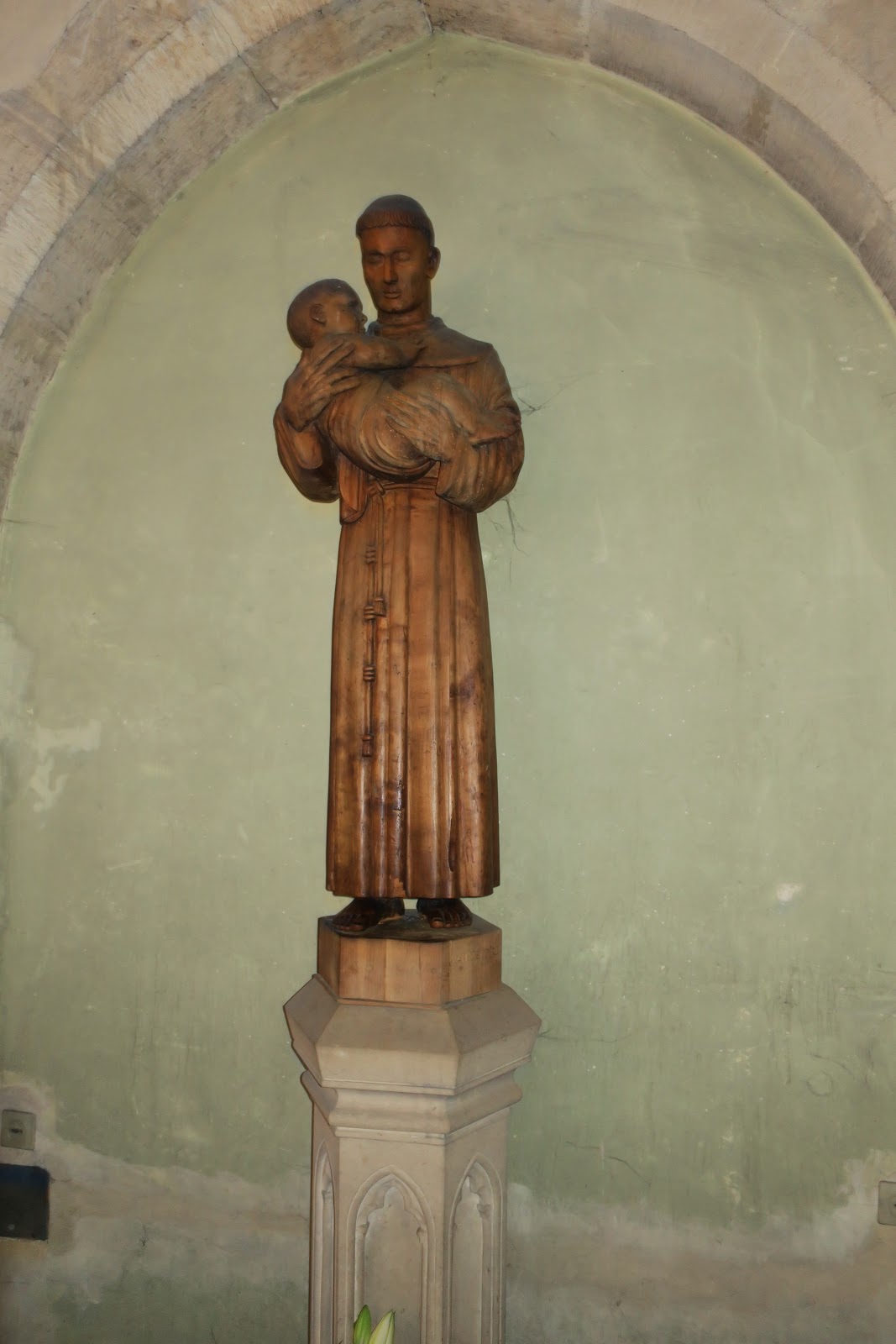
Inside the Church of Saint Michael in Cluj-Napoca, the statue of Saint
Anthony reflects these spiritual themes. Carved in wood and placed
within a stone niche, the figure holds the Christ Child in his arms,
emphasizing his mystical vision and deep love for Jesus. The statue's
serene expression and gentle posture invite contemplation and
reverence, offering a quiet reminder of Saint Anthony's role as a
spiritual guide and protector. Positioned within the sacred space of
the church, it serves as a focal point for prayer and reflection,
connecting visitors to centuries of faith and devotion.
|
|
Saint Joseph
Saint Joseph holds a central place in Catholic
Christianity as the earthly father of Jesus and the spouse of the Virgin
Mary.
-
He is revered as a model of humility, obedience, and silent strength.
His role in the Holy Family reflects deep spiritual values: he
protected and provided for Jesus and Mary without seeking recognition,
embodying the virtue of selfless service. As a carpenter, Joseph is
also honored as the patron saint of workers, symbolizing the dignity
of labor and the sanctity of everyday life. His quiet presence in
scripture speaks to the power of faith lived through action rather
than words.
-
Spiritually, Saint Joseph is seen as a protector of families and a
guide for fathers. He is invoked for his intercession in matters of
home, employment, and moral integrity. The lily often depicted with
him represents purity and his chaste relationship with Mary. His feast
days—March 19 and May 1—celebrate both his spiritual role and his
connection to labor. In Catholic devotion, Joseph is a figure of trust
and stability, reminding believers to remain faithful even in
uncertainty and to embrace their responsibilities with grace and
courage.
-
Inside the Church of Saint Michael in Cluj-Napoca, the statue of Saint
Joseph captures these qualities with quiet reverence. He is shown
holding the infant Jesus and a lily, combining symbols of paternal
care and purity. The statue's placement on an ornate pedestal within
the church emphasizes his importance in the spiritual life of the
community. Its presence invites reflection on Joseph's role as
guardian of the Holy Family and encourages visitors to seek his
example of steadfast love and devotion.
|
|
The pulpit
The pulpit of the Church of Saint Michael in
Cluj-Napoca is a masterful example of Baroque craftsmanship, created in
1740 by sculptor Johannes Nachtigall.
-
Elevated and richly decorated, it was designed not only as a
functional platform for preaching but also as a visual focal point
within the Gothic interior. The structure features intricate carvings
of biblical figures, angels, and ornamental scrollwork, all rendered
in wood with remarkable detail. Its canopy, supported by sculpted
elements, is crowned by a statue of an angel holding a cross,
symbolizing the divine authority of the Word being proclaimed from the
pulpit.
-
This pulpit reflects the Catholic tradition of emphasizing the spoken
word as a means of spiritual instruction and inspiration. Positioned
prominently within the nave, it underscores the importance of sermons
in guiding the faithful and interpreting scripture. The artistic
richness of the pulpit also serves a didactic purpose, visually
reinforcing theological themes through its iconography. As part of the
church's interior ensemble, it contributes to the overall harmony
between Gothic architecture and later Baroque embellishments, making
it a key element in the historical and spiritual experience of the
Church of Saint Michael.
|
|
The large censer
The large censer in the Church of Saint
Michael in Cluj-Napoca is a remarkable liturgical object, notable for
its elaborate design and ceremonial function.
-
Crafted from metal and adorned with intricate carvings, it reflects
the artistic sensibilities of the period in which it was made. The
censer is used during Mass and other religious services to burn
incense, a practice that symbolizes purification, sanctification, and
the prayers of the faithful rising to heaven. Its presence in the
church underscores the importance of sensory experience in Catholic
worship, where fragrance, light, and sound work together to create a
sacred atmosphere.
-
This particular censer stands out not only for its size but also for
its craftsmanship. Elevated on a decorative pedestal and topped with
spires and finials, it resembles a miniature Gothic tower, harmonizing
with the architectural style of the church itself. The use of incense
from such a prominent vessel enhances the solemnity of liturgical
rites, especially during high feast days and processions. As part of
the church's rich collection of religious furnishings, the censer
contributes to the continuity of tradition and the visual narrative of
devotion that defines the interior of Saint Michael's.
|
|
The main altar
The main altar of the Church of Saint
Michael in Cluj-Napoca is a striking example of Gothic and Baroque
fusion, reflecting the layered history of the building itself.
-
Positioned at the eastern end of the church, the altar serves as the
liturgical and visual focal point of the interior. It features an
elaborate ensemble of statues, carvings, and floral ornamentation,
with the central figure often identified as the Virgin Mary, flanked
by saints and angels. The altar is elevated and framed by tall stained
glass windows that depict biblical scenes, casting colored light
across the sanctuary and enhancing the spiritual atmosphere.
-
This altar not only fulfills its ceremonial role but also embodies
centuries of artistic devotion. Its design invites contemplation and
reverence, drawing the eye upward in keeping with Gothic verticality.
The combination of sculptural detail and architectural framing creates
a sense of sacred space that connects the earthly with the divine. As
part of the church's broader restoration efforts, the altar has been
carefully preserved and maintained, ensuring that its historical and
spiritual significance continues to inspire worshippers and visitors
alike.
|
See Also
Source
Location